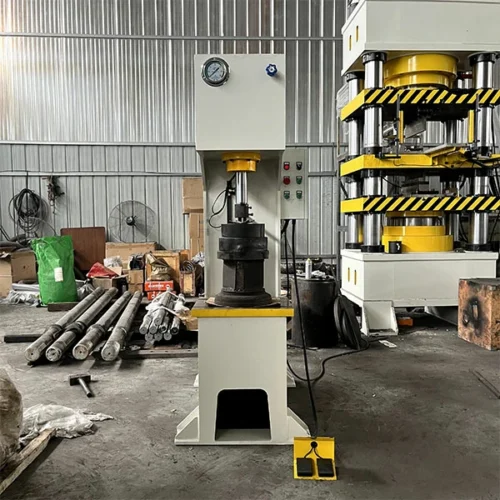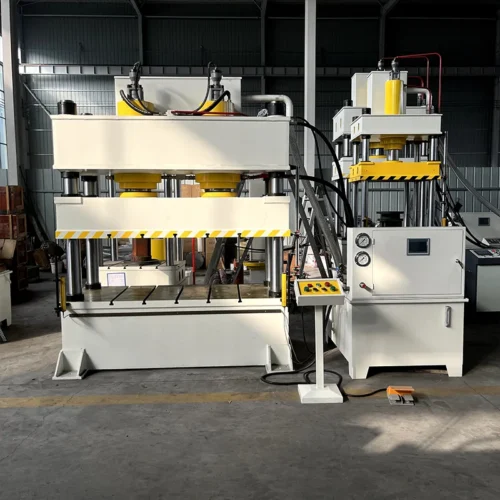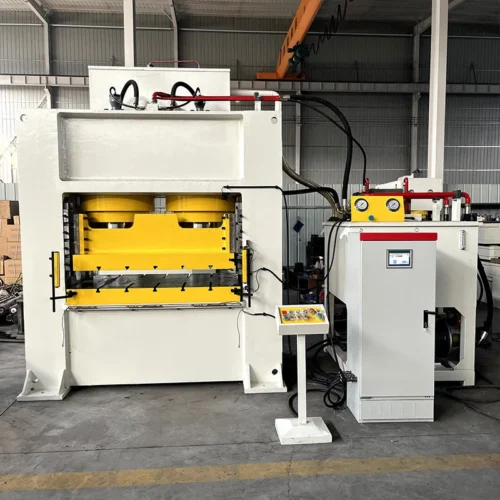

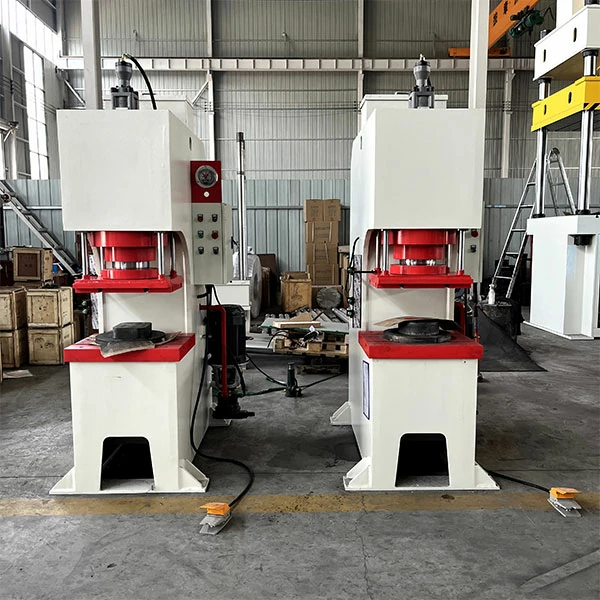
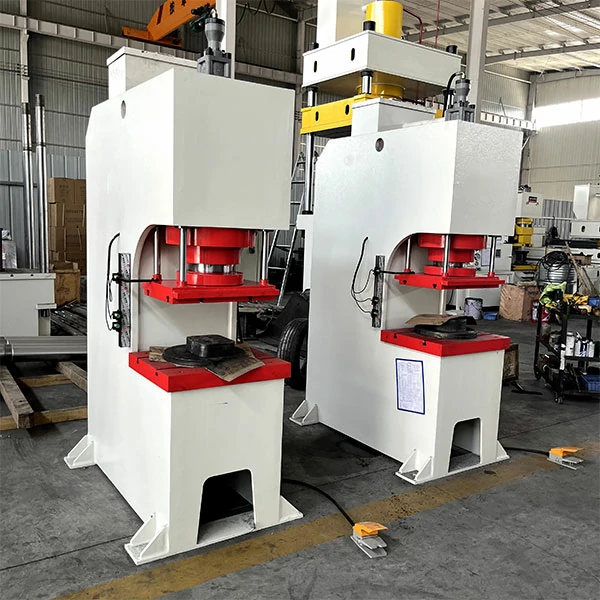
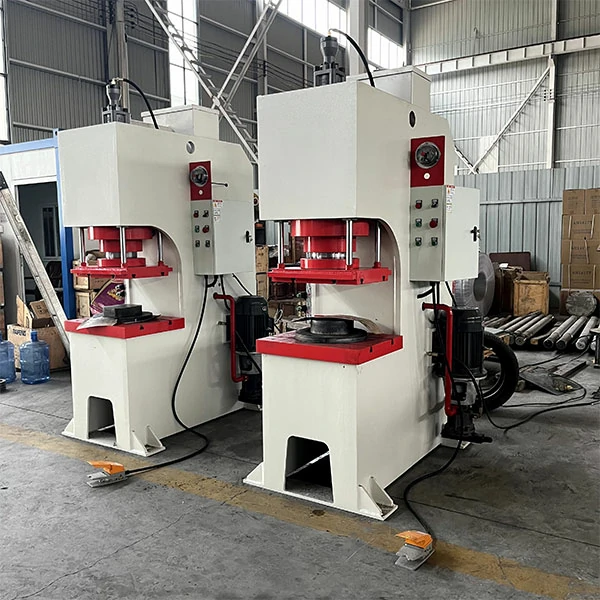
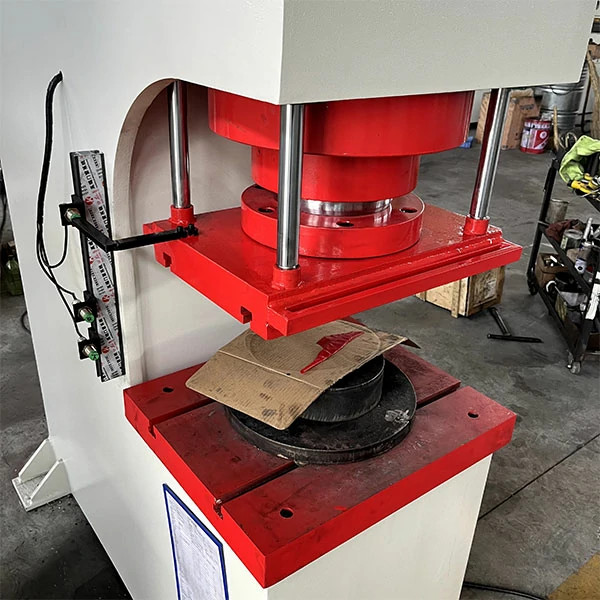
A 100 ton c frame hydraulic press with a 500 × 400 mm ram plate provides a larger contact area for distributing ram load across larger tooling. This becomes more important when the fixture face approaches the size of the ram plate. When tooling extends beyond the ram plate, load distribution depends on the fixture design, support conditions and plate stiffness, rather than tonnage alone.
The 600 × 500 mm worktable provides a compact working envelope for a 100 ton class machine. The 300 mm stroke provides useful ram travel for a range of press-fit, assembly and straightening operations, subject to the part geometry and required working depth. A standard foot pedal switch allows hands-free operation, and a 5.5 kW motor running on 380V covers the pump demand for this tonnage class.
100 Ton C Frame Hydraulic Press Key Features
When the tooling face on an assembly fixture spans close to the full 500 × 400 mm ram plate, the load distributes more effectively across that footprint. This helps keep multi-point press-fit work seated at a consistent depth across the full fixture. This configuration is suitable for press-fit assembly and straightening applications where the available working area and tooling access match the part requirements.
The 600 × 500 mm worktable provides a practical working envelope for this tonnage class while keeping the machine suitable for compact assembly workstations.
The available stroke length accommodates typical press-fit depths without requiring a second partial stroke to finish the seating pass, depending on the specific tooling setup.
The standard foot pedal switch allows the operator to initiate the press cycle without using a hand-operated control, while the workpiece is positioned in accordance with applicable safeguarding procedures. This is important for assembly work where the operator guides a part into a fixture.
This machine is not sized for high-cycle-rate continuous punching production; a Hydraulic Power Press suits that faster, continuous stroke pattern better than a single-cycle assembly press like this one.
Application Suitability
- Best suited for: Press-fit assembly, bushing and bearing installation, shaft straightening, and fixture-based assembly.
- Not intended primarily for: High-cycle continuous punching, or deep drawing applications requiring specialized tooling or greater working depth. Applications requiring heavy off-center loading should be reviewed against the frame design and load position before ordering.
Control and Operation Features
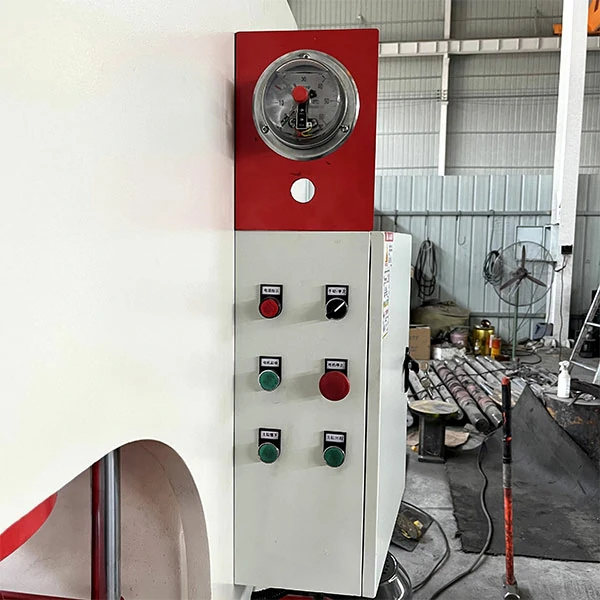
The standard foot pedal switch moves ram activation from a hand-operated valve to a foot-operated control. This allows the operator to initiate the press cycle without using a hand-operated control. Appropriate point-of-operation safeguarding is still required based on the machine configuration and application.
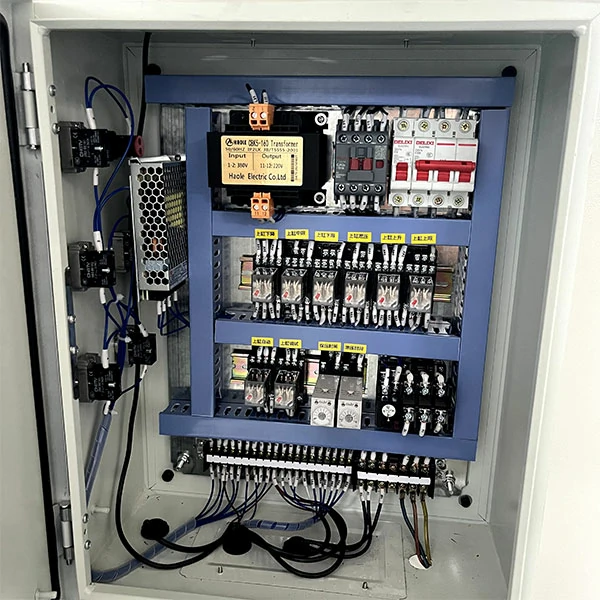
Depending on the required safety and automation level, optional configurations may include light curtains, two-hand control stations, and PLC-based control interfaces.
Note: On multi-point fixtures approaching the full 500 × 400 mm ram plate dimensions, verify fixture-to-ram alignment before running production, as off-center loading on a C-frame can affect seating consistency.
Engineering Insights and Buyer Considerations
Assembly work that spans a large fixture face requires even load distribution and safe, hands-free control. When a fixture extends beyond the ram plate, load distribution should be evaluated based on fixture stiffness, support conditions and the position of the applied load. A hand-triggered valve also requires the operator to use a hand to initiate the cycle, which can complicate manual fixture positioning.
This 100 ton assembly press machine pairs a 500 × 400 mm ram plate with a foot pedal switch, providing a larger contact area for fixtures that are appropriately sized and supported for the available ram plate, while allowing the operator to maintain control of the workpiece positioning throughout the press cycle.
Machine guarding and operator controls should be configured according to the applicable safety requirements for the installation location and intended application, particularly when using foot pedal activation.
Technical Specifications
| Parameter | Value |
|---|---|
| Rated Tonnage | 100 tons |
| Worktable Effective Area | 600 × 500 mm |
| Ram Plate Size (main cylinder) | 500 × 400 mm |
| Open Height (Daylight) | 300 mm |
| Stroke | 300 mm |
| Control | Foot pedal switch |
| Motor Power | 5.5 kW |
| Voltage | 380V |
Standard Configuration and Core Components
As a 100 ton assembly press machine built for wide-fixture work, this model pairs a large ram plate with foot pedal control.
- C-frame welded body structure
- 500 × 400 mm ram plate
- Foot pedal switch control
- 5.5 kW motor, 380V
Commissioning and Maintenance Notes
Floor mounting should be leveled and anchored before first use, since an uneven base can transfer uneven load into the frame arm over repeated cycles.
Because ram activation runs through a foot pedal switch, guarding around the pedal itself matters as much as guarding around the ram and worktable to prevent accidental activation while the operator’s hands are near the press area.
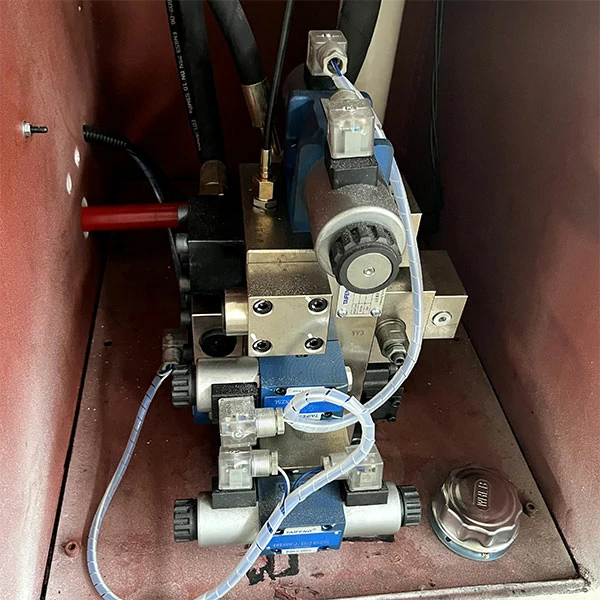
Hydraulic oil cleanliness, hose connections, seals, and mounting fasteners should be checked periodically during operation.
Frequently Asked Questions
Should I choose a C-frame or four-column press for wide-fixture assembly work?
A C-frame provides open front and side access, which can simplify loading and positioning of fixtures without guiding them between posts. A Four Column Hydraulic Press generally provides a more enclosed and guided structure for applications where alignment and load distribution are critical. The choice depends on whether load access or clamping stability matters more for the fixture in question.
Can the 100 ton C-frame press handle fixtures close to the full 500 × 400 mm ram plate width?
Fixtures that span close to the full 500 × 400 mm ram plate benefit from a larger contact area for load distribution. However, a fixture extending beyond the ram plate should be evaluated for load distribution, plate stiffness, and support conditions rather than relying on the 100 ton rating alone.
What does the foot pedal switch change compared to a hand-triggered control?
A hand-triggered valve requires one hand to leave the workpiece to start the stroke. The foot pedal switch allows the operator to initiate the press cycle without using a hand-operated control, while the workpiece is positioned in accordance with applicable safeguarding procedures.
Why does the ram plate size matter separately from the tonnage rating?
Tonnage describes total force, but the ram plate determines the contact area over which that force is initially applied. A fixture wider than the ram plate requires careful evaluation of tooling stiffness and support to ensure effective clamping across the entire part.
What is the difference between ram plate size and worktable size?
The worktable (600 × 500 mm) defines the available working area for mounting the bottom fixture or die. The ram plate (500 × 400 mm) defines the contact area of the moving cylinder that applies the downward force. Your tooling must be designed to fit within both dimensions.
What electrical supply is required for the 100 ton C-frame press?
The standard configuration requires a 380V, 3-phase, 50Hz electrical supply to power the 5.5 kW main motor. Customized voltage and frequency are available upon request to match local industrial requirements.
What should I confirm before ordering a 100 ton C-frame press for assembly production?
Confirm the fixture footprint against the 500 × 400 mm ram plate and 600 × 500 mm worktable, check that the 300 mm stroke covers the press depth needed, and verify the electrical supply matches your site’s setup.
How do I know whether 100 tons is enough for my assembly application?
Required pressing force depends on the part material, interference fit, contact area, tooling geometry and required assembly force. The 100 ton rating should not be selected from part size alone. Send the part drawing, material and pressing requirements for a force calculation and configuration review.
Confirming fixture footprint, ram plate coverage, and electrical supply before ordering avoids rework once a 100 ton c frame hydraulic press is set up for assembly production. Send us your part or fixture drawings so we can review the required tonnage, working area, and stroke before quotation.