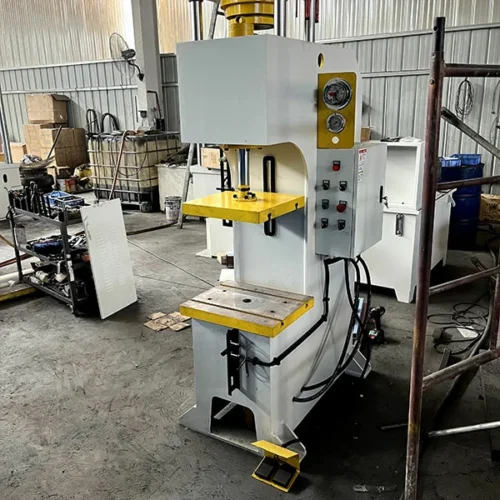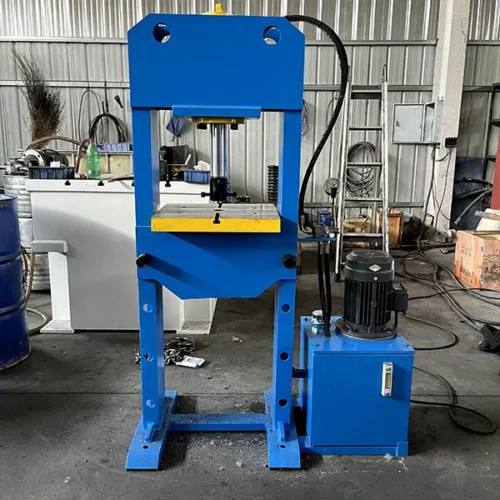

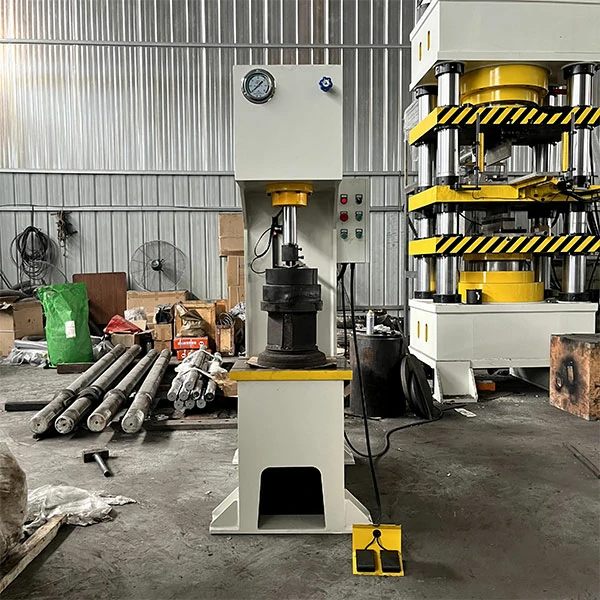
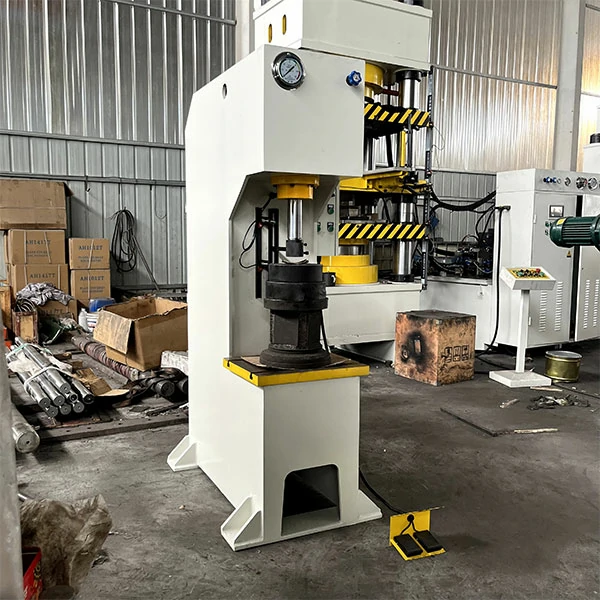
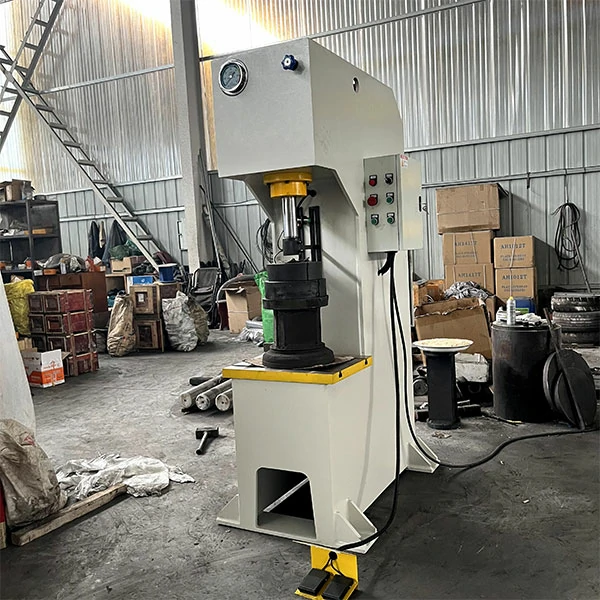
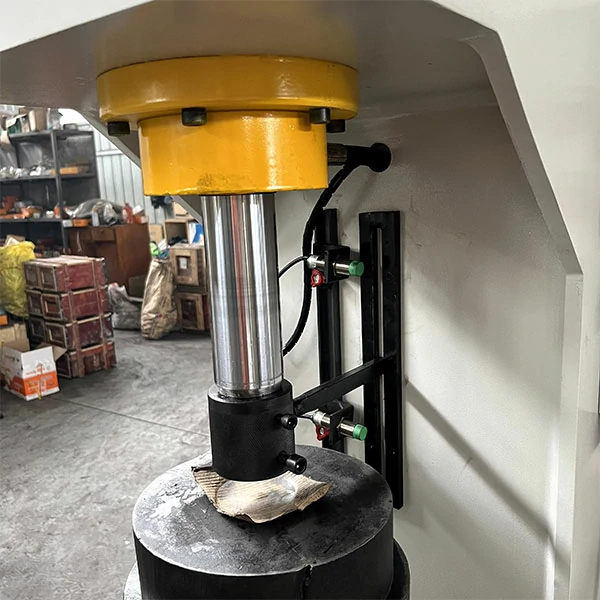
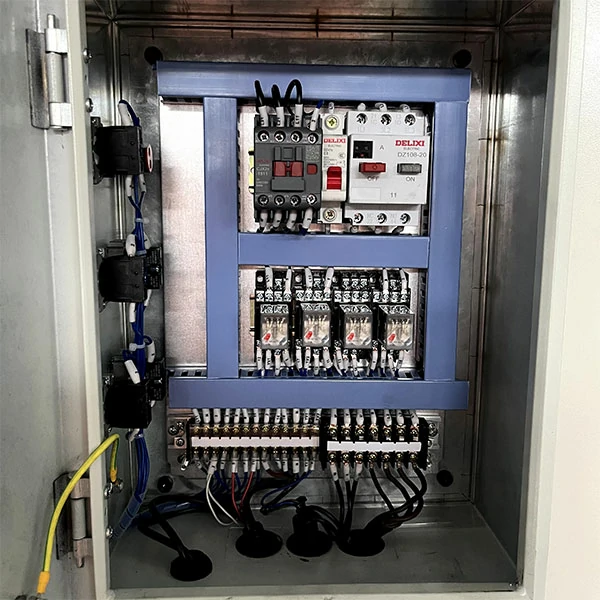
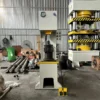
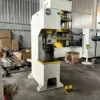
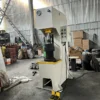
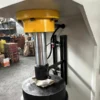
C-frame presses in the same tonnage class are not necessarily interchangeable, because table size, open height, stroke, and throat geometry determine what can actually fit and be processed. This 20 ton c frame hydraulic press provides a 500 × 400 mm worktable, 600 mm open height (daylight), and 260 mm stroke for press-fit assembly, straightening, and light punching applications.
A 260 mm stroke covers most press-fit and straightening depths on small to mid-size parts, and an 80 mm drop-through hole in the worktable allows punched slugs to fall clear of the bed instead of collecting on top of it. A 4 kW motor drives the pump for this tonnage class, sized for intermittent assembly and straightening cycles rather than continuous high-speed production.

20 Ton C Frame Hydraulic Press Key Features
The 500 × 400 mm worktable and 600 mm open height set the real limit on part size for this press, since a workpiece that fits between the frame throat and the table edge on paper still needs enough open height above it to load and unload without requiring full ram retraction each cycle.
A 260 mm stroke provides sufficient ram travel for many press-fit and straightening operations, although the required stroke depends on the part geometry, tooling height, and pressing depth.
The 80 mm drop-through hole in the worktable allows punched slugs to fall clear during straightening or light punching work, preventing them from stacking up under the part being pressed.
A 4 kW motor maintains steady pump output for the pressing and dwell phase typical of assembly work, though it is not sized for high-cycle-rate punching production; a Hydraulic Power Press suits that faster, continuous stroke pattern better.
Engineering Insights and Buyer Considerations
An open-front C-frame design provides direct access to the worktable, which is useful for assembly pressing where parts are frequently loaded and unloaded from the front. Compared with a four-column structure, the open frame also makes it easier to position irregularly shaped workpieces and fixtures within the available throat area.
The trade-off is that the C-frame is open at the front rather than fully enclosed, so pressing force applied out toward the front of the throat opening puts more bending load on the frame arm than the same force applied close to the frame body. That bending can contribute to ram or platen deflection and reduced alignment under off-center loading. On a 20 ton machine this deflection stays small in absolute terms, but it is still the reason straightening work with a long part extending well out from the frame should be positioned as close to the column as the part geometry allows.
Note: For repeat assembly work, keep the fixture and pressing point as close to the frame body as practical. Applying the load farther into the throat increases frame deflection and may reduce alignment consistency, particularly during straightening operations.
Technical Specifications
| Parameter | Value |
|---|---|
| Rated Tonnage | 20 tons |
| Worktable Effective Area | 500 × 400 mm |
| Open Height (Daylight) | 600 mm |
| Stroke | 260 mm |
| Worktable Drop-Through Hole Diameter | 80 mm |
| Motor Power | 4 kW |
Standard Configuration and Core Components
As a small c frame hydraulic press, this model keeps the footprint compact while still covering typical press-fit and straightening depths.
- C-frame welded body structure
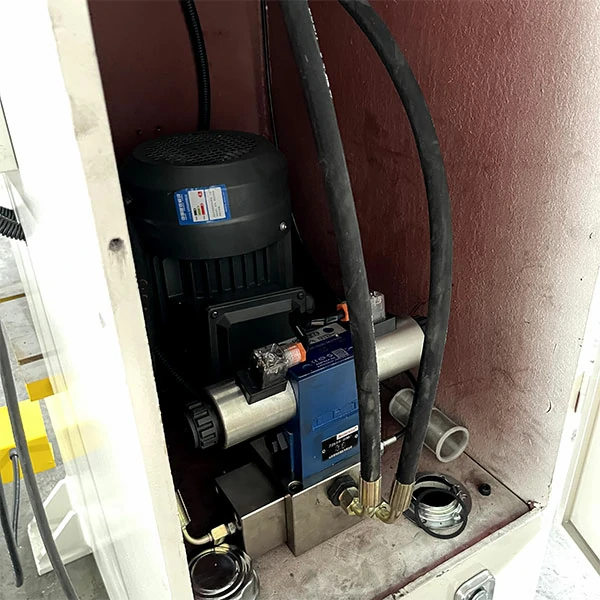
- 4 kW motor-driven pump unit
- Worktable with 80 mm drop-through hole
Commissioning and Maintenance Notes
Floor mounting should be leveled and anchored before first use, since an unlevel base can transfer uneven load into the frame arm over repeated cycles even at this tonnage.
Because the open-front design leaves the pressing area accessible from the front and open sides, guarding around the ram and worktable should follow applicable machine guarding requirements, particularly on repeat assembly work where hands move in and out of the press area frequently. See the OSHA machine guarding requirements for general requirements.
Hydraulic oil cleanliness, hose connections, seals, and mounting fasteners should be checked periodically during operation.
Frequently Asked Questions
What are the main advantages of a C-frame press over a four-column design for assembly work?
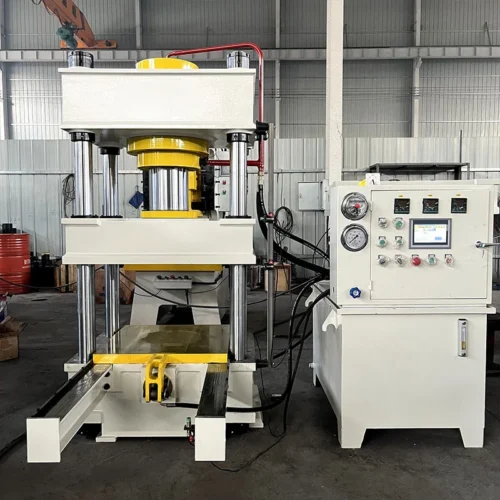
An open-front C-frame lets you load and unload parts from the front and open sides, which can be useful for repeat assembly work. A four-column hydraulic press generally provides a more enclosed and guided structure for applications where alignment and load distribution are critical. The right choice depends on the workpiece geometry, loading position, and required production process.
Can this 20 ton C-frame press handle straightening on parts extending well out from the frame?
Straightening work extending well out toward the throat opening puts more bending load on the frame arm than the same force applied close to the frame body, so this 20 ton class is best suited to parts that sit reasonably close to the column rather than long sections cantilevered far out from the frame.
What does the 80 mm drop-through hole in the worktable get used for?
The 80 mm drop-through hole lets punched slugs or scrap pieces fall clear of the worktable during light punching or straightening work, instead of collecting under the part and throwing off flatness on the next cycle.
What should I check before ordering a 20 ton assembly press for repeat production?
Confirm the part footprint against the 500 × 400 mm worktable and 600 mm open height of this 20 ton assembly press, check that the 260 mm stroke covers the full press-fit or straightening depth needed, and verify whether the work sits close to the frame body or extends toward the throat opening.
What applications are best suited to a 20 ton C-frame hydraulic press?
A 20 ton C-frame hydraulic press is well suited to press-fit assembly, straightening, light forming, and other intermittent pressing operations involving relatively small workpieces. Applications requiring high production rates, deep drawing, or large working areas may require a different press configuration.
Confirming part footprint, load position, and stroke depth before ordering avoids rework once a 20 ton c frame hydraulic press is set up for assembly or straightening work. Send us your part drawings and pressing requirements for a machine configuration review.