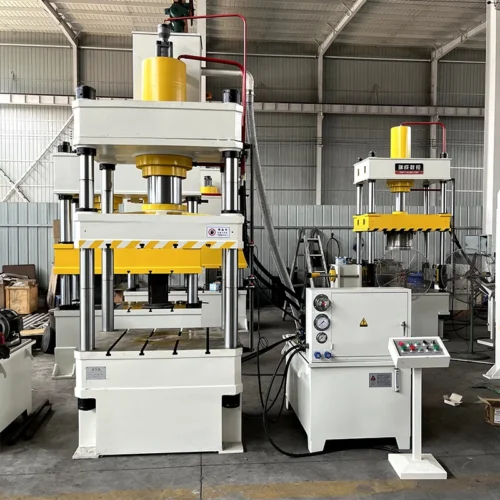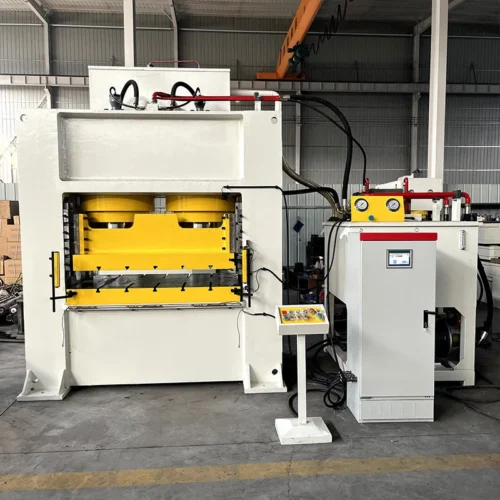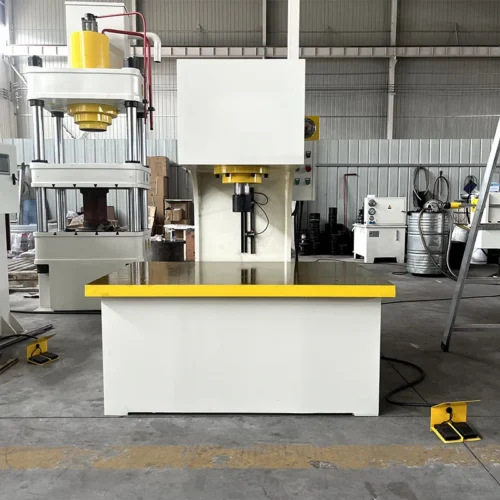

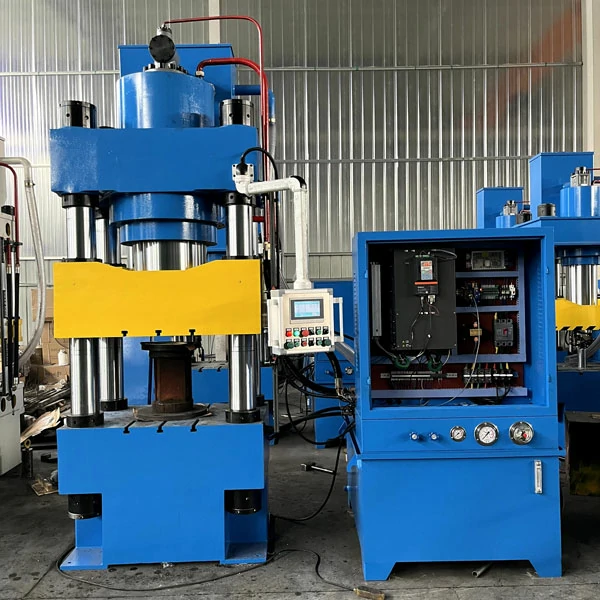
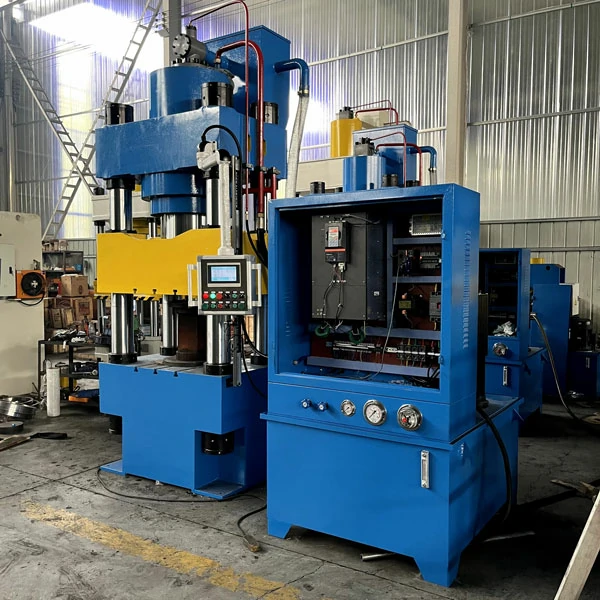
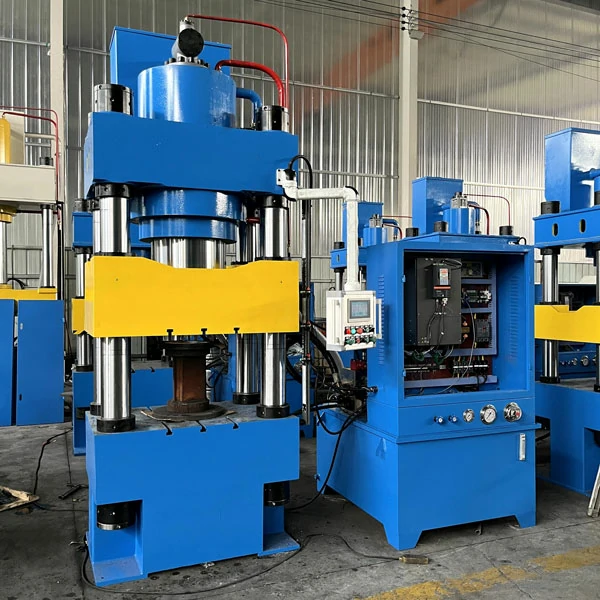
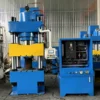
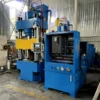
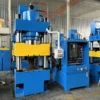
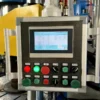
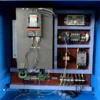
This model has a 900 mm × 900 mm effective worktable, 800 mm open height, and a 400 mm stroke, giving a larger working envelope for mold bases and heavy forming dies. A swing-arm control pendant rounds out the standard build, while an optional servo-driven pump provides demand-based flow control during heavy pressing cycles. This heavy duty four column hydraulic press is suited to manufacturers moving up from mid-tonnage equipment where available table space has become a limiting factor.
630 Ton Four Column Hydraulic Press Key Features
When a mold base spans close to the full column-to-column width, the 900 mm × 900 mm worktable and 800 mm open height allow many large dies and mold bases to be accommodated without splitting the tooling into multiple setups, subject to the actual die footprint and mounting requirements. Automotive parts and heavy plate forming both benefit from that wider forming envelope, since compatible multi-cavity tooling can stay mounted as one piece across a full production run.
For manufacturers looking for a 630 ton hydraulic forming press, the combination of 630-ton rated force, 900 × 900 mm worktable and 800 mm daylight provides a practical working envelope for heavy forming and pressing applications.
A 400 mm stroke provides substantial ram travel for many forming and pressing applications. Whether the stroke is sufficient depends on the required forming depth, die height, and part geometry, so verifying these parameters against the machine’s daylight is recommended before tooling design.
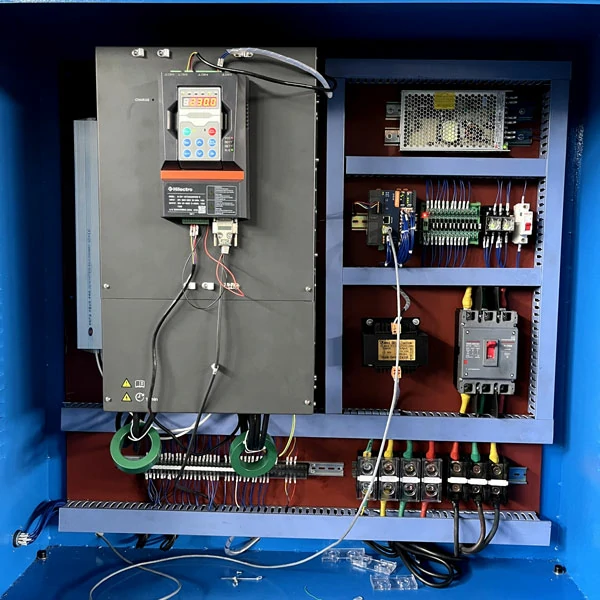
The optional servo-driven pump can adjust hydraulic output according to load demand, helping reduce energy consumption during dwell and positioning phases compared with a conventional fixed-displacement system.
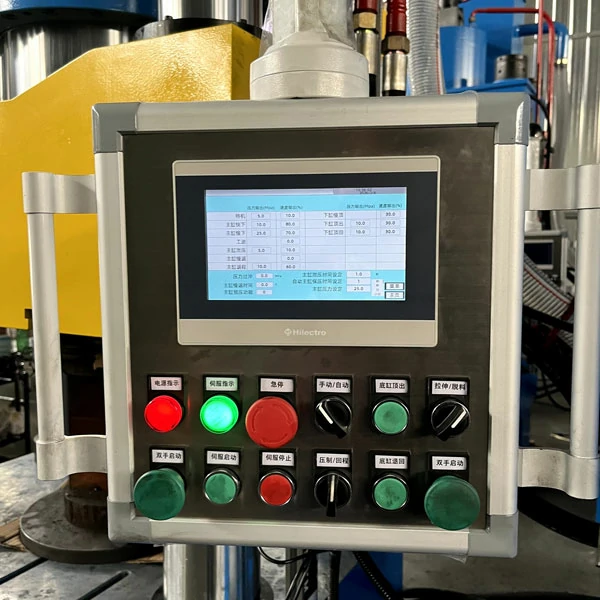
Compared to a fixed control station bolted to the frame, the swing-arm control pendant moves with the operator toward the loading side of the table, which counts for more on a 900 mm wide bed where reaching a stationary panel from the far corner slows down manual die changes between cycles.
This structure is not the right fit for very large sheet-metal panels needing open access from three sides; a Gantry Hydraulic Press design removes the side column obstruction for that handling pattern.
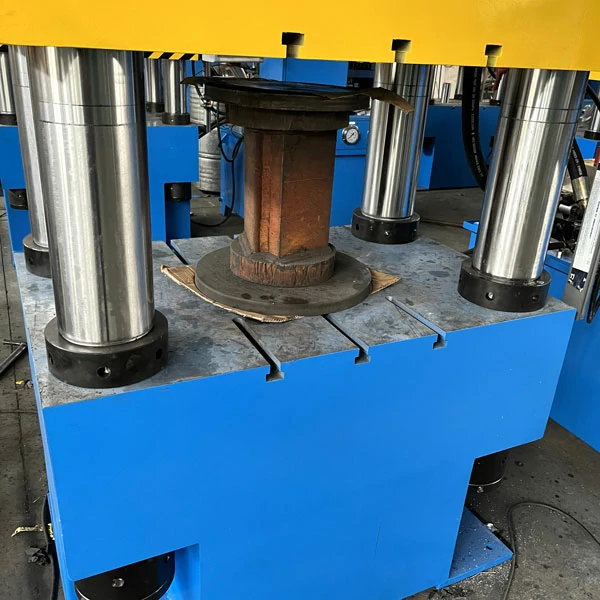
Optional Configurations
The servo-driven pump option replaces the standard fixed-displacement pump with a variable-output unit that tracks pressing load in real time, so flow output ramps down automatically once the ram reaches holding pressure. That behavior lowers heat buildup in the hydraulic tank during long production runs and keeps oil temperature more stable across a full shift, which matters more on large-format tooling where dwell time per cycle runs longer than on smaller stamping jobs.
The swing-arm control pendant option mounts on a rotating arm rather than a fixed post, so the operator can swing the control station toward either side of the 900 mm table depending on how the mold is loaded. On dies fed from one side only, that flexibility removes the extra walking distance a fixed panel would otherwise add between the loading point and the control buttons.
Note: on a 900 mm wide bed, position the swing-arm pendant on the same side as the primary loading point before final anchor bolts are set. Relocating it after installation means redrilling the mounting plate.
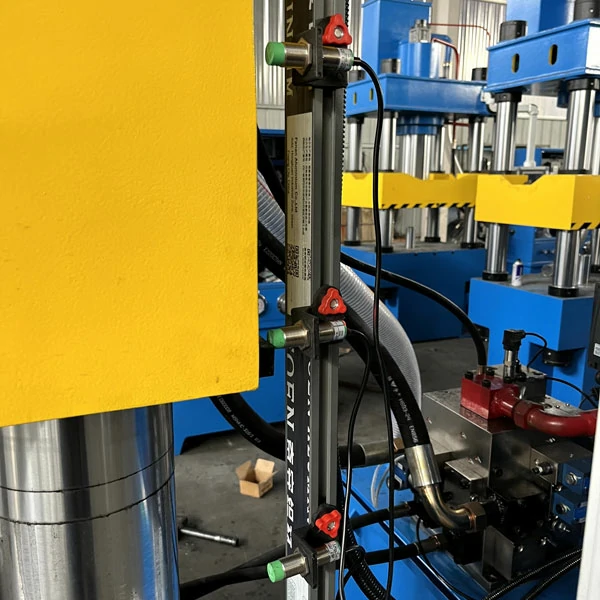
Engineering Insights and Buyer Considerations
Shops running large mold bases for heavy plate forming or oversized automotive brackets typically need two things a mid-tonnage four column press does not provide together: a worktable wide enough to hold the full tool without trimming the bolster, and flow control precise enough to avoid overshoot as the ram nears holding pressure on a large-area die. A fixed-displacement hydraulic system may require additional flow regulation during approach and pressure-holding stages, depending on the circuit design. A narrow worktable, on the other hand, forces the mold to be split into two setups or the bolster trimmed to fit — both add setup steps and re-alignment risk on large tooling runs.
This press pairs the 900 mm × 900 mm worktable and 800 mm open height with an optional servo-driven pump, so the tool sits in the frame as one piece and the ram slows on approach without manual throttling. The servo-driven system can provide more consistent flow control across repeated cycles when properly configured, helping maintain repeatable approach and pressing behavior.
Technical Specifications
| Parameter | Value |
|---|---|
| Rated Tonnage | 630 tons |
| Worktable Effective Area | 900 × 900 mm |
| Open Height (Daylight) | 800 mm |
| Stroke | 400 mm |
| System Pressure | 25 MPa |
| Main Motor Power | 30 kW |
| Pump Drive | Servo motor |
| Control Station | Swing-arm control pendant |
| Approx. Machine Weight | 18,000 kg |
Standard Configuration and Core Components
- Four-column steel frame and guide structure
- Standard hydraulic pump unit
- Swing-arm control pendant
Quality Control and Manufacturing Verification
- Hydraulic system pressure test at 1.25 times nominal capacity before shipment
- Column straightness and cross-platen parallelism measurement across the full 400 mm stroke
- Functional verification of flow control shift timing and pressure transition
Available Customizations & Export Configurations
- Custom worktable sizes, stroke lengths, and daylight openings
- PLC touch-screen control systems with multi-step pressure and speed settings
- Voltage and frequency adapted to local industrial requirements (e.g., 380V/50Hz, 415V/50Hz, 220V/60Hz)
- Upgraded dedicated hydraulic cushion (blank-holder) systems for deep drawing applications
- Light curtain safety guards and CE-compliant safety configurations
- Standard export seaworthy packaging with anti-rust treatment and reinforced steel pallets
Commissioning and Maintenance Notes
Floor-mounted installation should include a level, reinforced base, since an uneven foundation can transfer load unevenly across the four columns over time. Column parallelism is worth checking again after the first weeks of production, once the frame has settled under repeated loading.
Guarding around the ram and bolster area should comply with the applicable machine safety requirements in the destination market. For U.S. installations, OSHA 29 CFR 1910.212 machine guarding requirements provide a relevant reference for protecting operators from hazardous moving parts and the point of operation.
Hydraulic oil cleanliness should be checked on a regular schedule, and any press left idle for an extended period should be cycled empty a few times to bleed air from the lines before loading a die.
Frequently Asked Questions
Why choose a four-column hydraulic press instead of a C-frame press for 630-ton applications?
A four-column design provides guided platen movement and good load distribution across a large working area, making it suitable for higher-tonnage forming applications. C-frame presses offer greater front access but are generally better suited to smaller workpieces and lower-tonnage applications. See the C Frame Hydraulic Press range for those lighter use cases.
Can a 630 ton four column press handle large stamping dies for automotive body brackets?
The 900 mm × 900 mm worktable and 800 mm open height provide a working envelope for many medium-to-large mold bases and heavy forming dies. Actual compatibility depends on the die footprint, mounting pattern, and required clearance.
Is the servo-driven pump worth choosing over a fixed-displacement system for large mold work?
For large mold production where dwell time per cycle runs longer than on small stamping jobs, the servo-driven pump reduces idle energy draw and gives smoother approach speed near holding pressure. On short-cycle, low-dwell work the benefit is smaller, so the fixed-displacement option can still make sense for lighter, faster jobs.
What does the swing-arm control pendant change compared with a fixed control panel?
A fixed control panel stays bolted in one spot, so operators loading from the far side of a 900 mm table walk further to reach it. The swing-arm pendant rotates toward the loading point instead, which cuts that walking distance on dies fed from one side only.
What should I confirm before ordering a heavy-duty four column press like this one?
Confirm the mold base footprint against the 900 mm × 900 mm worktable and 800 mm open height, check that the 400 mm stroke covers the full draw or form depth needed, and verify the floor foundation can support a machine in this tonnage class before installation.
Standard lead time is typically 45-60 days, backed by a 12-month warranty on core components. Confirming mold base dimensions, foundation load, and pump configuration before ordering avoids rework once a 630 ton hydraulic forming press is on the shop floor. Send us your die drawing, material specifications, required force, and cycle requirements for a machine configuration review.