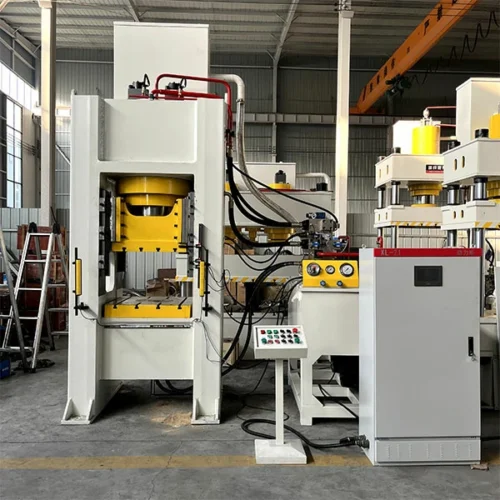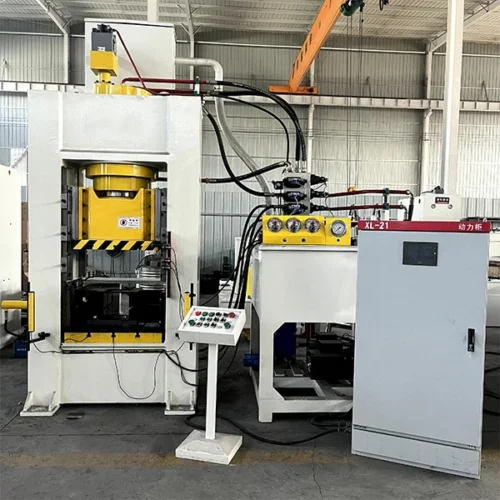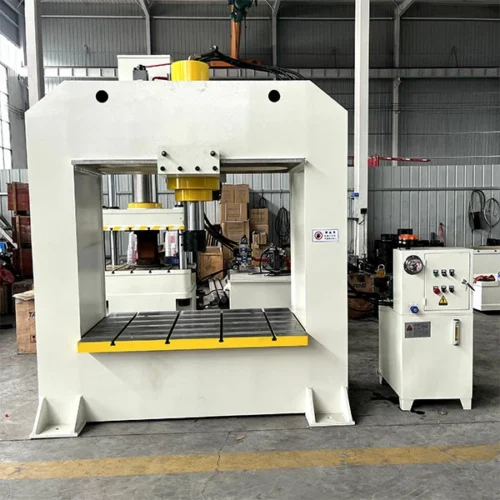

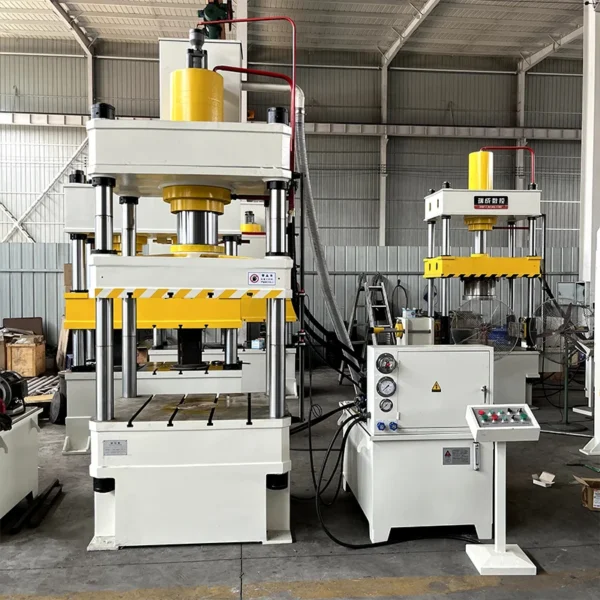
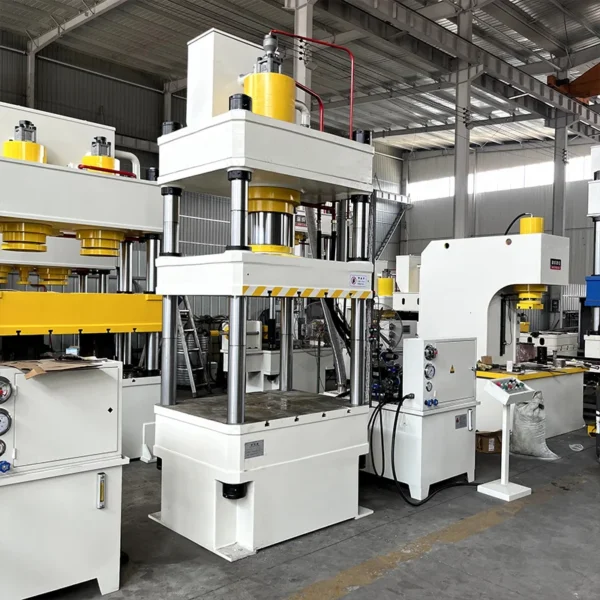
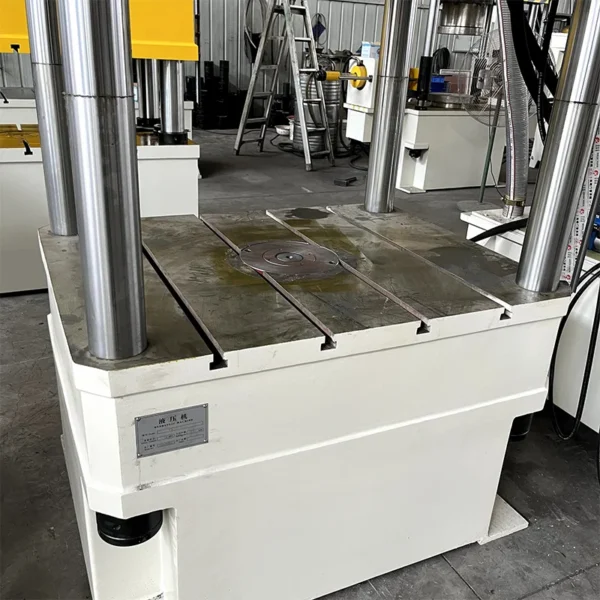
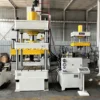
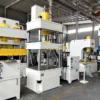
Many buyers assume that a 200 ton four column hydraulic press sits in an awkward middle ground — too small for heavy forging, too large for light assembly. That assumption misses the point. The YQ32-200 occupies a specific capacity window where single-action deep drawing, progressive stamping, and medium-tonnage compression molding all become feasible on one machine, without the floor-space penalty of a 1000-ton unit or the die-size restrictions of a 100-ton model. Its 2000 kN main cylinder and 280 kN ejector system distribute force across a 1000 × 940 mm table, making it the practical choice for production lines that need flexibility across multiple forming operations rather than specialization in one.
200 Ton Four Column Hydraulic Press – Key Structural and Performance Characteristics
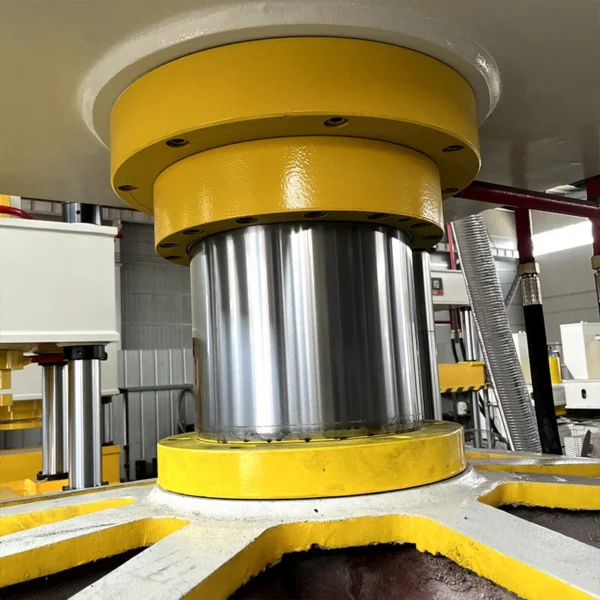
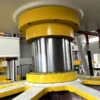
The YQ32-200 applies 200 tons of nominal force through a centralized hydraulic cylinder mounted in the upper crossbeam, which distributes that load evenly across four chrome-plated guide columns. This arrangement maintains ram parallelism within tight tolerances during off-center loading, so the press handles asymmetric die setups without the ram tilt that plagues single-column or C-frame designs. The 710 mm slide stroke provides enough vertical travel for deep-draw operations on parts up to roughly 400 mm draw depth, while the 1120 mm maximum shut height accommodates tooling stacks that include blank holders, draw rings, and ejector plates.
Compared to the YQ32-100, the 200-ton model more than doubles the ejecting force to 280 kN, which is necessary when stripping drawn cups or stamped shells from deep dies where vacuum adhesion and friction resistance increase with part depth. The same ejector, rated for a 200 mm stroke, also supports knockout of compression-molded parts where undercuts or draft angles create mechanical locking. The pressing speed range of 5–12 mm/s, adjustable via the hydraulic control circuit, allows operators to slow the ram for critical forming phases and then increase speed for return and idle strokes, improving cycle efficiency without sacrificing part quality.
Though the YQ32-200 handles a wide forming envelope, it is not the right choice for precision micro-stamping below 0.5 mm material thickness where C-frame presses with higher stroke rates and finer position control outperform four-column designs. For those applications, a C-frame hydraulic press with servo-hydraulic feedback delivers better results at lower cost. Note: When deep drawing stainless steel, ensure blank holder force reaches at least 35% of main cylinder force. Falling below this threshold makes corner wrinkling highly probable on draw depths exceeding 250 mm.
YQ32 Series Model Comparison – Selecting the Right Four Column Press
The YQ32 series spans from 63-ton light-duty units to 630-ton heavy-duty machines. Choosing between them depends on part geometry, material thickness, production volume, and available floor space. The table below compares the YQ32-200 against its nearest neighbors in the series to clarify where this model fits.
| Parameter | YQ32-100 | YQ32-200 (This Model) | YQ32-315 | YQ32-500 |
|---|---|---|---|---|
| Nominal Force | 1000 kN (100 tons) | 2000 kN (200 tons) | 3150 kN (315 tons) | 5000 kN (500 tons) |
| Ejecting Force | 190 kN | 280 kN | 630 kN | 1000 kN |
| Slide Stroke | 500 mm | 710 mm | 800 mm | 900 mm |
| Max. Shut Height | 800 mm | 1120 mm | 1250 mm | 1500 mm |
| Table Size (L×W) | 690×630 mm | 1000×940 mm | 1260×1160 mm | 1400×1400 mm |
| Main Motor Power | 7.5 kW | 15 kW | 22 kW | 2×22 kW |
| Machine Weight | 3700 kg | 9000 kg | 14000 kg | 25500 kg |
| Typical Applications | Light stamping, shallow drawing, small bracket forming | Medium deep drawing, progressive stamping, compression molding | Heavy deep drawing, large automotive parts, thick plate forming | Large structural forming, heavy forging, multi-cavity molding |
Engineering Insights – When to Choose the YQ32-200 Over Neighboring Models
If your production involves deep-drawn stainless steel kitchen sinks or automotive fuel tanks where draw depth exceeds 1.5 times blank diameter, the YQ32-100 lacks both the blank holder force and the slide stroke to complete the draw without tearing or wrinkling. The YQ32-200 solves this with its 710 mm stroke and proportionally higher ejector capacity, so it becomes the minimum viable choice for medium-depth drawing operations.
If you are forming thick-walled composite panels or large appliance housings that require consistent pressure across a 1000 mm table width, the YQ32-200 delivers uniform force distribution through its four-column guided platen, which is why it outperforms C-frame alternatives of similar nominal tonnage in applications where die span exceeds 600 mm. The C-frame throat depth creates a moment arm that amplifies deflection under asymmetric loading, whereas the four-column box structure resists this tendency.
If your facility has limited floor space or overhead crane capacity below 10 tons, the YQ32-315 and YQ32-500 become impractical. The YQ32-200 at 9000 kg installs on standard reinforced concrete floors without specialized foundation work, so it fits existing workshops where heavier machines would require structural reinforcement. That said, if your process demands simultaneous multi-point forming on dies larger than 1000×940 mm, the 200-ton table size becomes a hard constraint, and you should step up to the YQ32-315 or larger.
Technical Specifications
| Parameter | Metric | Imperial |
|---|---|---|
| Main Cylinder Capacity | 2000 kN (200 Tons) | 440,925 lbs |
| Ejecting Force | 280 kN (28.5 Tons) | 62,960 lbs |
| Return Force | 240 kN (24.5 Tons) | 53,970 lbs |
| Slide Stroke | 710 mm | 27.95″ |
| Ejecting Stroke | 200 mm | 7.87″ |
| Max. Shut Height | 1120 mm | 44.09″ |
| Table Size (L×W) | 1000×940 mm | 39.37″×37.01″ |
| Slide Speed – Idle Down | 120 mm/s | 4.72″/s |
| Slide Speed – Pressing | 5–12 mm/s | 0.20–0.47″/s |
| Slide Speed – Return | 95 mm/s | 3.74″/s |
| Ejecting Speed – Eject | 80 mm/s | 3.15″/s |
| Ejecting Speed – Return | 145 mm/s | 5.71″/s |
| Main Motor Power | 15 kW | 20 HP |
| Machine Weight | 9000 kg | 19,842 lbs |
| Overall Dimensions (L×W×H) | 2650×1350×3800 mm | 104.3″×53.1″×149.6″ |
Standard Configuration and Core Component Details
- Three-beam four-column structure with HT250 cast iron crossbeams and chrome-plated guide columns
- Cartridge valve integrated hydraulic system with centralized manifold design
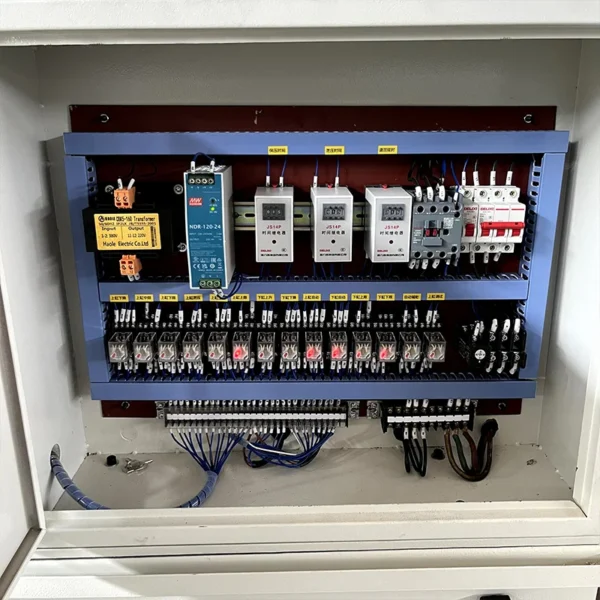
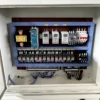
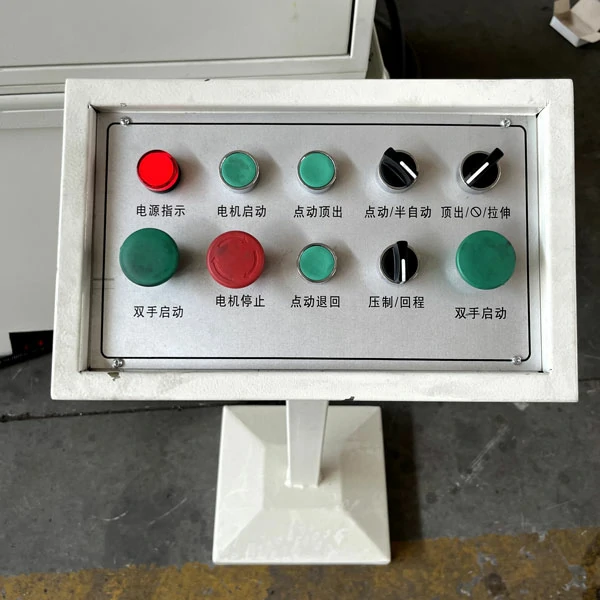
- PLC-based electrical control with push-button operation panel
- Independent hydraulic power unit with 15 kW motor and variable displacement pump
- Adjustable working pressure and stroke limits via control interface
- Single-cycle and semi-automatic operation modes
- Lower cylinder ejector with 200 mm stroke and adjustable ejecting speed
- Safety light curtains and emergency stop circuits integrated into control logic
Quality Control and Manufacturing Verification
- Each press undergoes full-load pressure testing at 1.25× nominal capacity before shipment
- Guide column parallelism verified with dial indicators across full stroke length
- Hydraulic system pressure-hold test: 30 minutes at maximum working pressure with leakage inspection
- Slide speed calibration performed at idle, pressing, and return stages against specification tolerances
- Frame stress-relief heat treatment applied to welded and cast structural components
Frequently Asked Questions
How does the YQ32-200 compare to the YQ32-100 for deep drawing operations?
The YQ32-200 offers a 42% longer slide stroke (710 mm vs 500 mm) and 47% more ejecting force (280 kN vs 190 kN), which makes it the minimum viable choice when draw depth exceeds 200 mm or when stripping deep-drawn parts from complex dies. The YQ32-100 handles shallow draws and light stamping efficiently but reaches its limit on medium-depth automotive or appliance components.
Should I choose the YQ32-200 or the YQ32-315 for my production line?
Select the YQ32-200 if your parts fit within a 1000×940 mm die area and your material thickness stays below 6 mm for mild steel. The YQ32-315 becomes necessary when forming thick plates above 8 mm, when die size exceeds 1200 mm in either direction, or when blank holder force requirements exceed 400 kN. The 200-ton model saves approximately 5,000 kg in machine weight and requires no specialized foundation beyond standard 200 mm reinforced concrete.
Four-column vs C-frame: which structure fits a 200-ton stamping application?
For stamping dies wider than 600 mm or applications with off-center loading, the four-column design maintains ram parallelism and resists the angular deflection that C-frame presses experience due to throat depth geometry. C-frame presses suit narrow dies and operations requiring front access, but the four-column box structure of the YQ32-200 provides superior rigidity for multi-cavity or wide-progressive dies.
What hydraulic system upgrades are available for the YQ32-200?
Optional configurations include a servo-driven pump system for variable flow control during forming cycles, proportional valve packages for programmable pressure profiling, and heated platens for thermoplastic or composite molding. A quick-acting cylinder package can increase idle stroke speed to 150 mm/s for high-cycle stamping applications. Contact our engineering team to match upgrade options to your specific process requirements.
Selecting between the YQ32-100, YQ32-200, and YQ32-315 requires matching your part geometry, material specifications, and production volume to the right capacity window. The wrong choice leads to either underutilized capacity and excessive floor-space consumption, or insufficient force and premature die wear. Send us your part drawings and material details — we will calculate the required tonnage, blank holder force, and stroke profile, then recommend the specific model and configuration for your forming line.