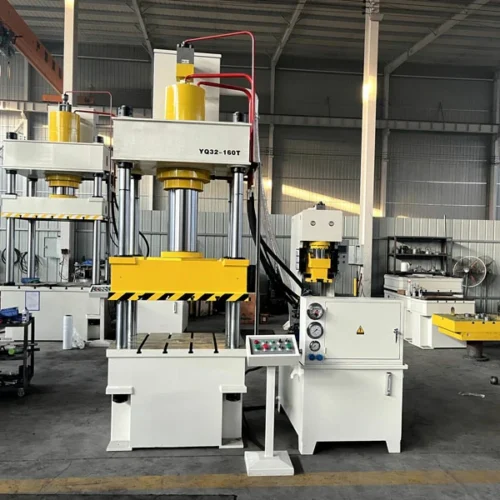

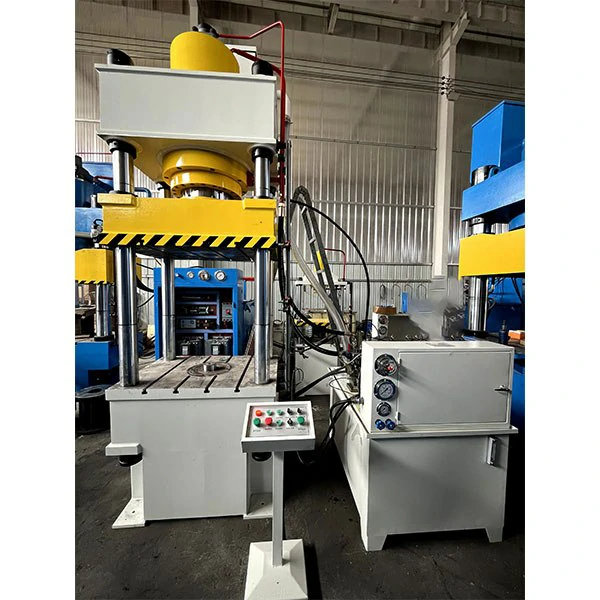
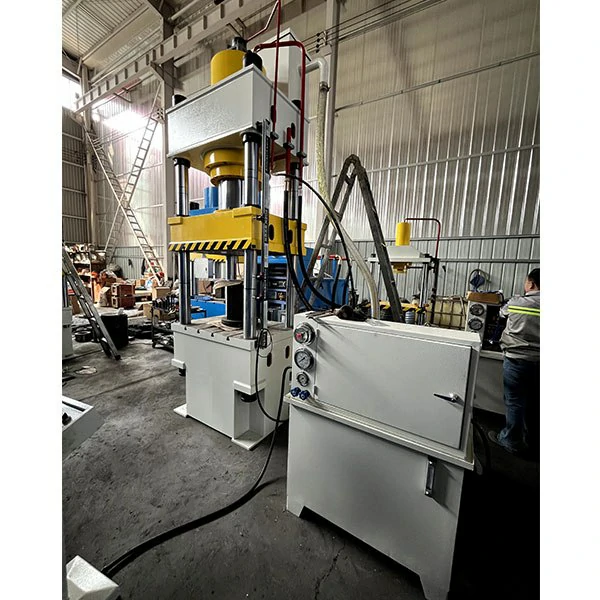
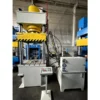
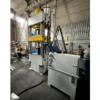
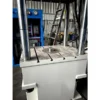
Deep-drawn parts that come off the die with uneven wall thickness usually trace back to blank holder force that can’t keep pace with draw depth, and that’s exactly the gap a 315 ton four column hydraulic press is built to close. With a single 315-ton main cylinder, 600mm stroke, and an 800 x 800mm working table, this three-beam four-column press gives sheet metal forming, deep drawing, and general assembly pressing operations enough force and clearance to run consistent parts across longer production batches. A 63-ton lower ejector cylinder handles demolding independently of the main ram, so part removal doesn’t compete with the forming stroke itself.
315 Ton Four Column Hydraulic Press Quality Control and Manufacturing Verification
Manufacturing verification on this press follows standard hydraulic equipment practice rather than a single generic sign-off. The main cylinder and the 63-ton lower ejector cylinder are each pressure-tested before final assembly, the three-beam four-column frame is checked for squareness against the working table, and a full no-load cycle followed by a loaded cycle test confirms that slide travel and ejector timing match the rated stroke figures.
- Pressure testing of main cylinder and lower ejector cylinder before assembly
- Frame squareness check between columns and working table
- No-load and loaded cycle verification against rated stroke
- Ejector timing check relative to main ram position
Measurement methods used for these checks are consistent with general manufacturing quality references published on the NIST Manufacturing Portal, which covers common test and measurement practices for industrial forming equipment.
Key Features of the Three Beam Four Column Hydraulic Press
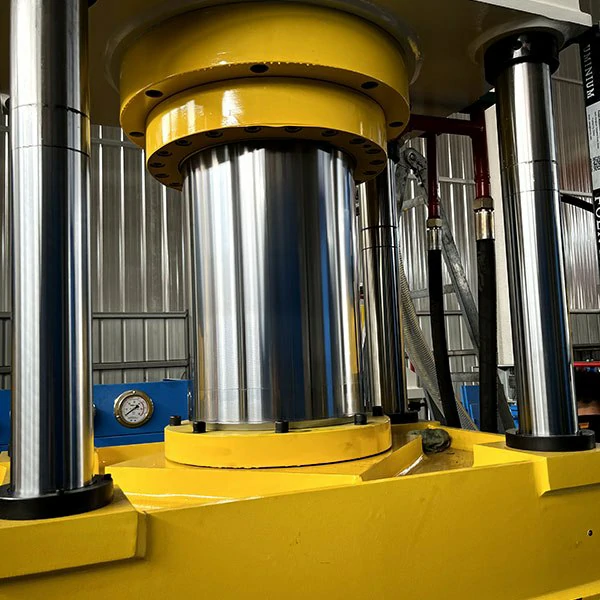
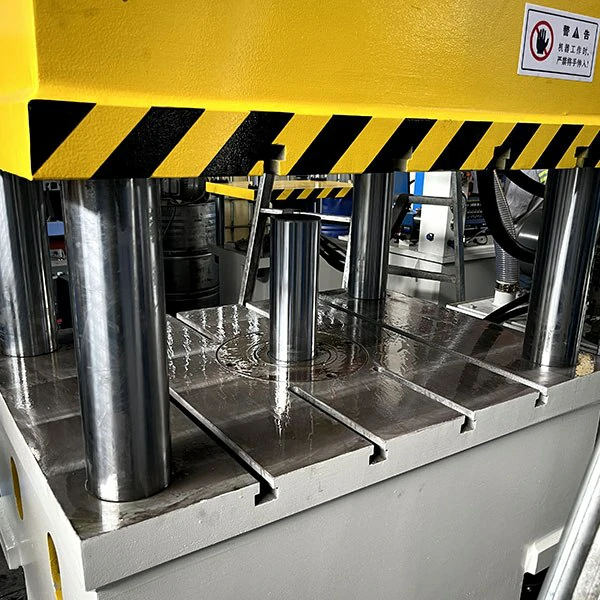
The 315-ton main hydraulic cylinder applies a single, centrally guided pressing force through the slide block, so the reaction load transfers evenly into all four columns instead of concentrating on one side of the frame during off-center die placement.
A 600mm cylinder stroke opens up the usable working envelope for taller die sets, because the extra travel lets the ram fully clear multi-stage tooling before the next cycle starts, without repositioning the mold between runs.
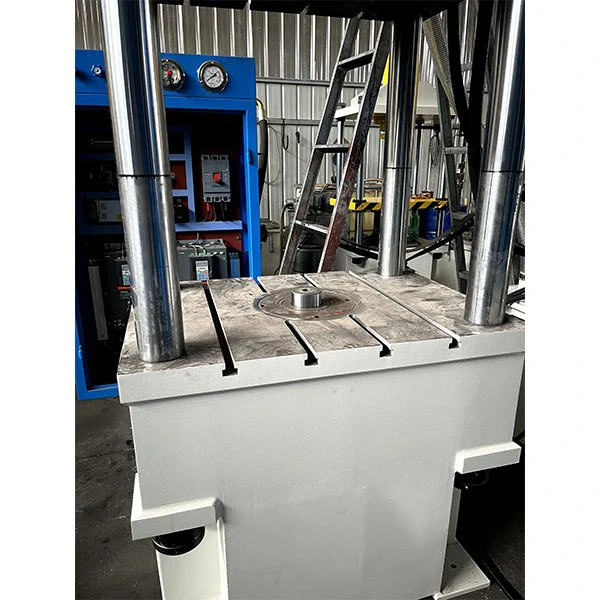
An 800 x 800mm working table paired with a 1000mm maximum daylight height accommodates wider mold bases; shops running narrower dies still gain from the extra clearance when stacking spacer blocks for shallower parts.
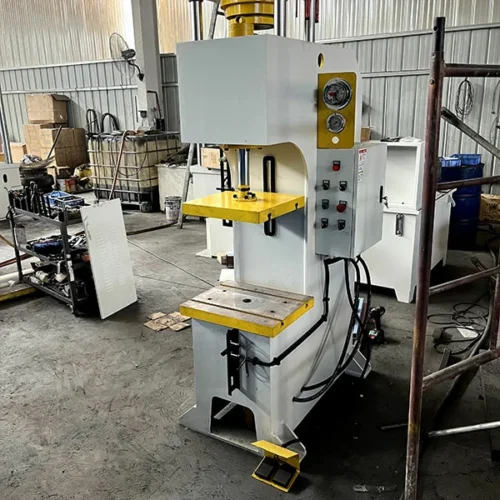
This four-column layout is not the most economical choice for light-duty, high-mix stamping under 20 tons where operators need open-front access and a smaller footprint; a C-Frame hydraulic press typically fits that lighter production pattern better.
The 63-ton lower ejector cylinder, rated at a 300mm stroke, pushes formed parts free of the lower die independently of the main ram, which keeps demolding force separate from the forming force and reduces surface drag on deep-drawn stainless steel or aluminum parts.
Note: on a 600mm stroke with 1000mm daylight, roughly 400mm of clearance remains once the ram is fully retracted, so die sets taller than about 380mm should be checked against actual mounting height before tooling is ordered.
Engineering Insights and Buyer Considerations
Routing 315 tons through a single centrally mounted cylinder means the full pressing load passes straight down the column centerline rather than splitting across two or more rams. Because the four columns share that load symmetrically, slide parallelism stays consistent even as blank holder pressure varies across a drawing cycle, so parts pulled from wider blanks keep more uniform wall thickness from the center of the draw out to the corners.
Because maximum daylight reaches 1000mm while the main cylinder stroke covers 600mm, roughly 400mm of static clearance remains at full ram retraction; that fixed clearance is what sets the tallest die set the press can accept without adding riser blocks or modifying the bolster. Buyers evaluating this press against a smaller four-column model should weigh that clearance figure against their tallest planned tooling, not just against nominal tonnage.
The independent 63-ton ejector system also changes how blank holder force can be tuned for deep drawing: because ejection doesn’t draw from the main cylinder’s pressing capacity, the full 315 tons stays available for holding and forming even on cycles that need firm part release, though extremely thin-wall parts may still need supplemental cushioning beyond what the ejector alone provides.
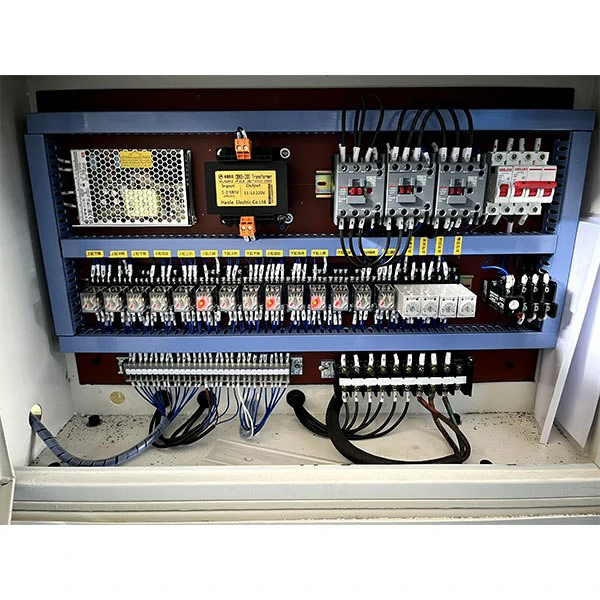
Regarding power configuration, the 15kW main motor is optimized for energy-efficient, standard-cycle production; for high-speed continuous stamping, a higher kW rating or servo-pump upgrade is recommended.
Four-Column vs. Gantry Hydraulic Press: A Quick Comparison
| Feature | 315T Four-Column Hydraulic Press | 315T Gantry Hydraulic Press |
|---|---|---|
| Off-Center Load Tolerance | High (Symmetrical load distribution across four guide columns minimizes ram tilt) | Moderate (Requires careful die centering; open sides offer less inherent guidance) |
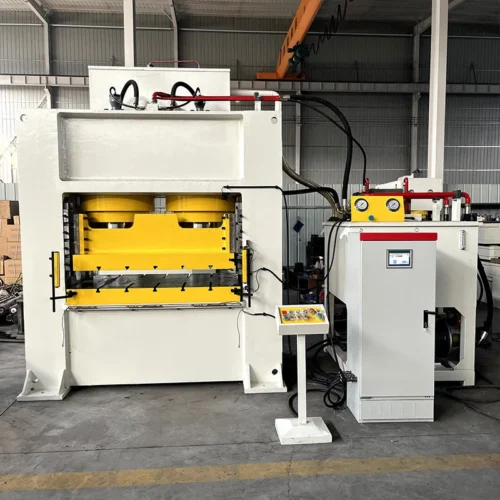
| Footprint & Accessibility | Compact, enclosed frame; best for medium-sized dies within the 800 x 800mm table | Larger footprint with open-side access; ideal for oversized or irregularly shaped workpieces |
| Tooling Change Speed | Fast and highly repeatable due to precise column guidance and fixed daylight parameters | Slower, often requiring manual alignment and additional support for heavy, wide dies |
Technical Specifications
| Item | Specification |
|---|---|
| Machine Type | 315 Ton Single Cylinder Four Column Hydraulic Press |
| Nominal Force | 315 Ton |
| Structure | Three Beam Four Column |
| Main Cylinder | Single Cylinder |
| Main Cylinder Stroke | 600 mm |
| Maximum Opening Height | 1000 mm |
| Working Table Size | 800 x 800 mm |
| Lower Ejector Force | 63 Ton |
| Lower Ejector Stroke | 300 mm |
| Main Motor Power | 15 kW |
Standard Configuration
The 315 ton four column hydraulic press ships with the following core structural components as standard:
- 315-ton single main hydraulic cylinder with 600mm stroke
- 63-ton lower ejector cylinder with 300mm stroke
- Three-beam four-column frame, including upper beam, sliding block, and four guide columns
- 800 x 800mm working table
- 15kW main drive motor
Commissioning and Maintenance Notes
Installation and ongoing upkeep for this tonnage class follow general hydraulic press practice. Foundation leveling and anchor bolt torque should be confirmed before first operation, since an uneven base transfers load unevenly into the four columns over time.
- Check column and guide parallelism after installation and after any relocation
- Inspect hydraulic oil cleanliness on a regular schedule
- Calibrate ejector cylinder timing relative to main ram position
- Bleed the full hydraulic circuit during initial commissioning and after hose replacement
- Recheck limit switch settings after any tooling change that alters working height
These steps reflect standard commissioning practice for four-column hydraulic presses in this tonnage range rather than model-specific data, and should be confirmed against the installation manual supplied with the machine.
Frequently Asked Questions
How does the ejector cylinder affect part removal during deep drawing?
The 63-ton lower ejector works independently of the 315-ton main cylinder, pushing the formed part free of the lower die once the main ram retracts. Because ejection force isn’t drawn from the forming stroke, operators get consistent release timing on deep-drawn parts without adding drag marks from delayed demolding.
Four-column vs gantry hydraulic press: which fits large workpiece forming?
A four-column press like this 315-ton model suits medium-sized dies within an 800 x 800mm table and benefits from guided column rigidity on off-center loads. For workpieces wider than the table or requiring open-side loading, a gantry hydraulic press generally handles the larger footprint more practically.
Can this four-column press handle off-center loading without ram tilt?
The four guide columns share load symmetrically around the slide, which limits tilt compared to single-post designs when the die sits slightly off the table center. Extreme off-center loading beyond typical die placement still increases wear on the guide bushings over time.
Is a servo pump upgrade worth considering for this tonnage class?
A servo-driven pump reduces idle power draw and improves cycle repeatability on presses running frequent, varied cycles, but the standard fixed-displacement pump on this 315-ton press is usually adequate for shops running steady batch sizes with predictable stroke timing.
Is 315 tons the right capacity for automotive bracket and deep-drawing production, or should a different tonnage be considered?
For automotive brackets and mid-depth stainless steel draws using an 800 x 800mm die footprint, 315 tons generally provides enough blank holder margin. Shallow stamping under 50 tons or workpieces narrower than the table may run more economically on a smaller four-column or C-frame model.
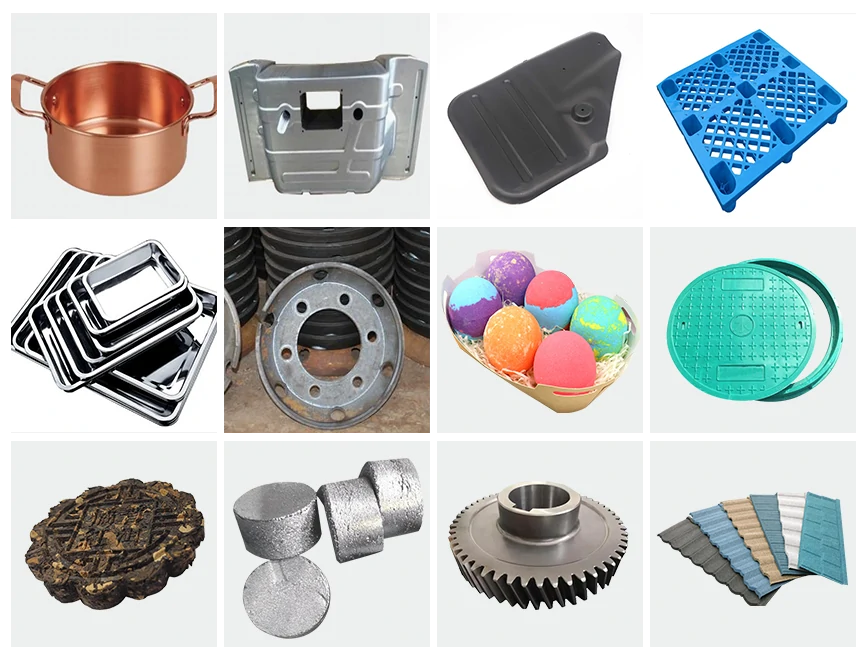
Choosing the right tonnage and stroke for deep drawing or general metal forming depends on blank size, draw depth, and how much daylight the tallest die set actually needs. If you’re comparing this 315 ton four column hydraulic press against other tonnage options in the series, our team can review the die dimensions and cycle requirements with you before you commit to a configuration.