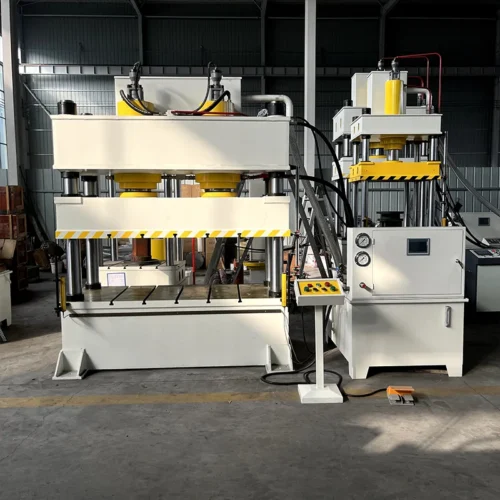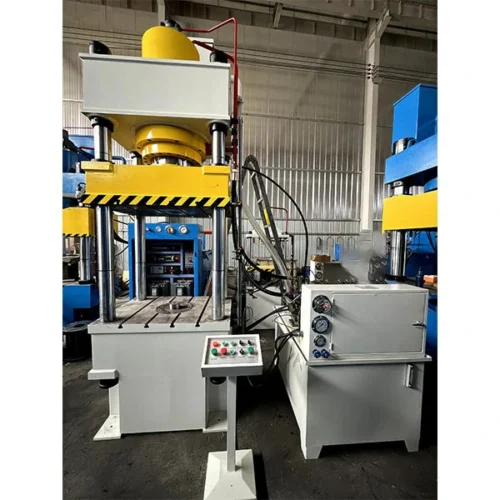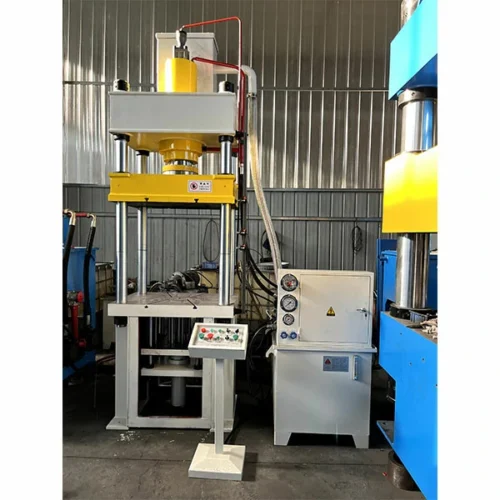

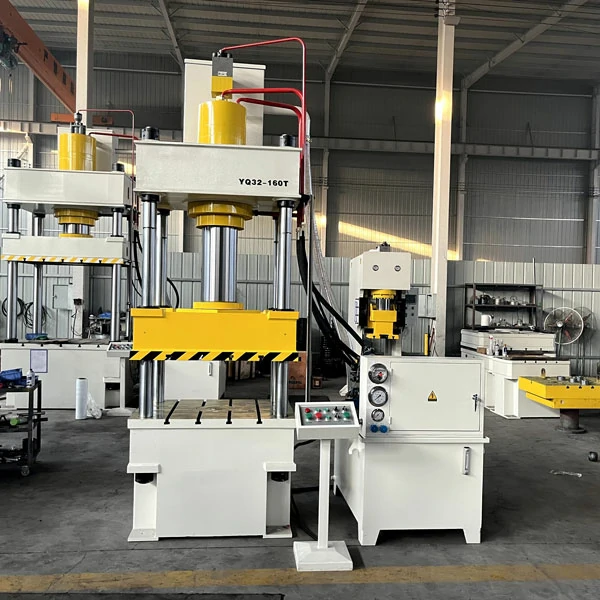
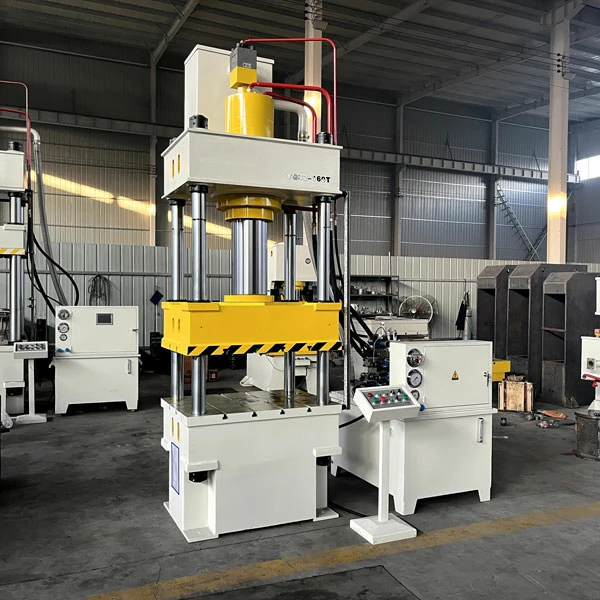
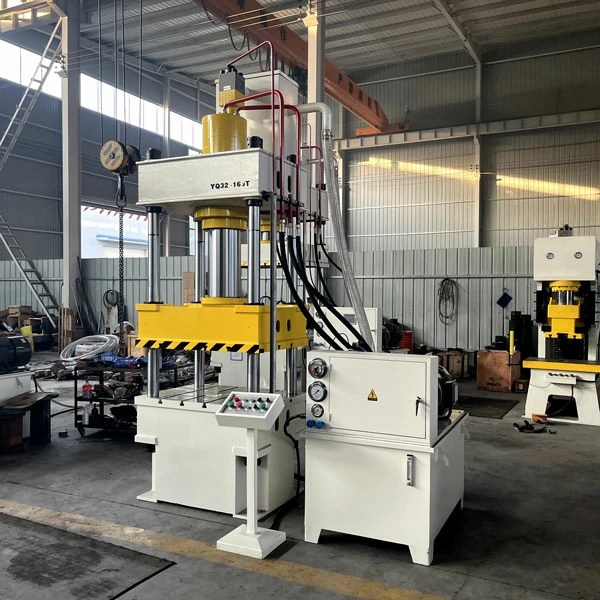
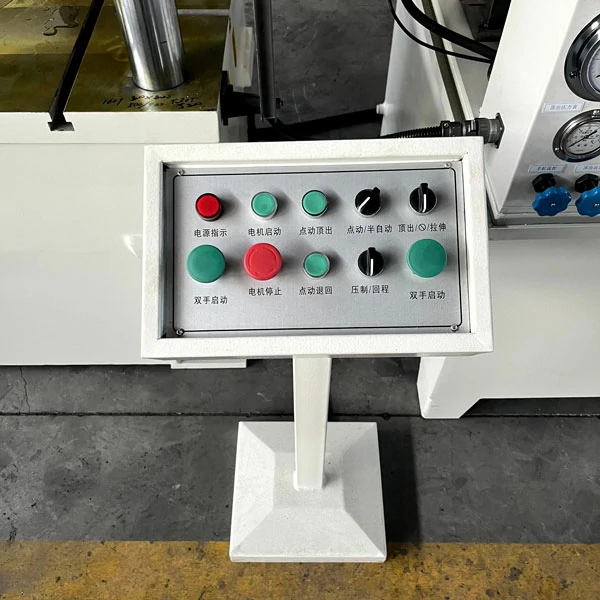
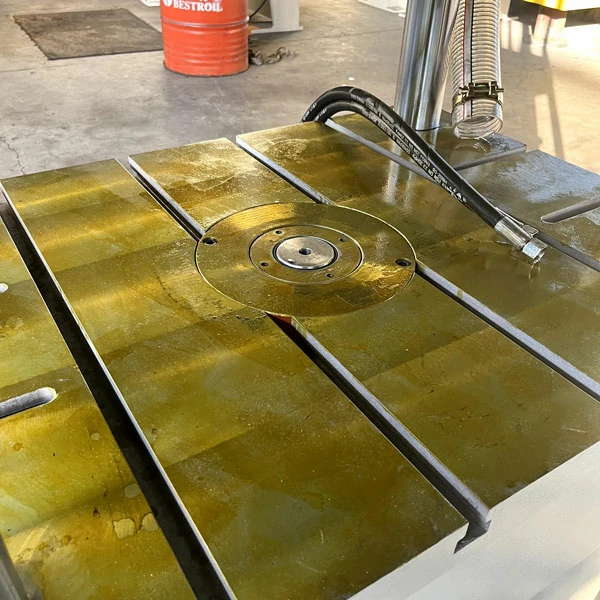
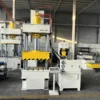
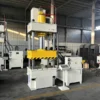
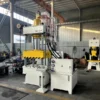
Engineered for versatility, this 160 ton four column hydraulic press provides stable forming performance for both precision metal forming and heavy-duty bearing pressing. By pairing a 500 mm slide stroke with 900 mm of open daylight and a four-column guide structure, it helps maintain tight platen parallelism and consistent part quality across the entire 800 by 800 mm worktable, helping reduce setup errors caused by mismatched press configurations.
Quality Control and Manufacturing Verification
- Hydraulic system pressure test at 1.25 times nominal capacity before shipment
- Column straightness and cross-platen parallelism measurement across the full stroke
- Functional verification of quick-approach circuit shift timing and pressure transition
- Ejector force and stroke calibration against design specification
160 Ton Four Column Hydraulic Press: Key Features and Structural Design
This 160 ton four column hydraulic press applies its rated force through a centralized main cylinder supported by four alloy-steel columns. Often selected by facilities needing a reliable small four column hydraulic press for precision tasks, this structure distributes pressure evenly across the 800 by 800 mm worktable and reduces the risk of ram tilt during off-center bearing pressing operations.
The 900 mm daylight provides substantial vertical die space for a wide range of shallow forming and medium-depth tooling. The 500 mm slide stroke allows sufficient travel for forming, pressing, and drawing operations, accommodating both shallow embossing dies and medium-depth draw tools. This generous vertical clearance simplifies manual part loading and die alignment during setup, making it a well-suited 160 ton hydraulic forming press for varied production runs.
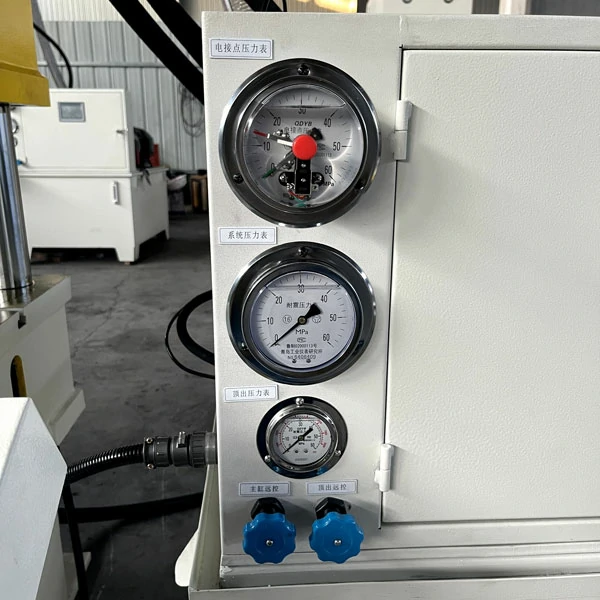
The main cylinder on this 160 ton four column hydraulic press incorporates an internal fast-approach circuit that works in tandem with the 40YCY variable displacement pump and the 11 kW drive motor. During each cycle, the ram advances rapidly under low-pressure flow until the tool contacts the blank, at which point the system switches automatically to high-pressure forming speed. This two-stage hydraulic sequence reduces idle approach time on repetitive small-part stamping and bearing pressing cycles, so overall batch throughput improves without increasing heat load on the oil reservoir. Because the pump only outputs full flow during the brief forming phase rather than throughout the entire stroke, energy consumption can be reduced compared to traditional fixed-displacement systems under typical cycle profiles.
When drawing depth stays below roughly 200 mm on mild steel blanks up to 3 mm thick, the 30-ton hydraulic ejector with 200 mm return stroke knocks out formed parts cleanly from the lower die, because the ejector force is sufficient to break friction between the die shoulder and the drawn shell without causing secondary deformation.
While the 800 by 800 mm worktable and 160-ton capacity cover most small metal parts forming and bearing pressing dies, this press is not the optimal choice for large automotive panel forming or progressive die sets that require platen areas above 1000 by 1000 mm; for those applications, a closed frame hydraulic press with extended bed offers better platen support.
Engineering Insights and Buyer Considerations
The 800 by 800 mm worktable dimension on this heavy-duty four column press defines the usable die envelope rather than the physical frame size. Four-column guidance with hardened alloy-steel posts and bronze bushings helps maintain platen parallelism across the full stroke, reducing the risk of ram tilt and excessive deflection under off-center loads. This helps prevent wall-thickness variation in drawn cups or uneven embossing depth in decorative sheet metal panels.
Because the frame is open on all four sides, operators gain full access for die loading and part removal from any direction, which is why this structure is widely used in small-batch metal forming shops. That same openness, however, means the column span limits absolute rigidity compared with a closed-frame stress loop; if your application involves powder compaction or composite molding where even minor platen deflection under sustained high pressure causes density variation or fiber washout, a closed frame design is the more appropriate choice.
With a 500 mm stroke and 900 mm daylight, the press generates useful working energy across a broad mid-stroke range rather than only at bottom dead center. The hydraulic system can deliver the rated forming force throughout the working stroke when operated within the specified pressure range. Consequently, deep drawing operations on soft steel benefit from consistent force, unlike mechanical presses whose available force varies with crank position. For small metal parts forming, this means consistent wall thickness across the drawn shell even when the blank diameter approaches the upper limit of the worktable area.
Technical Specifications
| Parameter | Specification |
|---|---|
| Nominal Force | 160 ton |
| Worktable Effective Area | 800 x 800 mm |
| Max Daylight (Opening Height) | 900 mm |
| Slide Stroke | 500 mm |
| Ejector Force | 30 ton |
| Ejector Stroke | 200 mm |
| Motor Power | 11 kW |
| Main Cylinder Feature | Built-in quick approach cylinder |
| Hydraulic Pump Model | 40YCY |
Standard Configuration and Core Components
- 11 kW main drive motor
- 40YCY variable displacement hydraulic pump
- Main cylinder with built-in fast-approach circuit
- 30-ton hydraulic ejector with 200 mm stroke
- Four-column alloy-steel guide structure
Typical Applications
- Small to medium metal parts forming and stamping
- Bearing, bush, and sleeve pressing / assembly
- Sheet metal flanging, embossing, and shallow drawing
- Straightening and calibration of shafts or profiles
Available Customizations & Export Configurations
- Custom worktable sizes, stroke lengths, and daylight openings
- PLC touch-screen control systems with multi-step pressure and speed settings
- Voltage and frequency adapted to local industrial requirements (e.g., 380V/50Hz, 415V/50Hz, 220V/60Hz)
- Upgraded dedicated hydraulic cushion (blank-holder) systems for deep drawing applications
- Light curtain safety guards and CE-compliant safety configurations
- Standard export seaworthy packaging with anti-rust treatment and reinforced steel pallets
Commissioning and Maintenance Notes
Note: A reinforced concrete foundation (thickness to be determined by site soil conditions and dynamic load calculations, often starting at 200 mm for standard workshop floors) is highly recommended, because vibration from off-center stamping can compromise ram alignment over time on insufficient bases.
- Level the press on a reinforced concrete foundation and tighten anchor bolts before first operation
- Check column parallelism after the first month of operation and following any foundation settling
- Monitor hydraulic oil contamination levels; replace filters if particle count exceeds normal thresholds
- Calibrate limit switches for stroke end points and ejector return position
- Bleed the hydraulic system after oil changes or extended shutdown periods to prevent cavitation
Frequently Asked Questions
Can a four-column press handle off-center loading without ram tilt?
The four-column guided structure helps maintain platen parallelism across the full 500 mm stroke and reduces the risk of ram tilt under off-center loads within the worktable area during bearing pressing or asymmetric stamping.
What is the difference between daylight and stroke in a hydraulic press?
Stroke is the maximum distance the slide can travel up and down. Daylight (or opening height) is the maximum distance between the upper and lower platens when the slide is at the top of its stroke. Daylight determines the maximum die height you can install, while stroke determines the forming distance.
What floor foundation requirements apply to a 160-ton four-column press?
A reinforced concrete foundation is required, with the exact thickness verified against site soil bearing capacity, machine weight, and dynamic load calculations (often starting at 200 mm for standard installations). This helps prevent long-term alignment issues caused by vibration.
What materials and applications is this 160 ton press suitable for?
This press is versatile for forming mild steel, stainless steel, aluminum, and copper alloys. Typical applications include bearing pressing, small metal parts stamping, sheet metal flanging, shallow drawing, and straightening operations.
Can the hydraulic press be customized with PLC control and specific voltage?
Yes. We offer fully customizable PLC touch-screen control systems for multi-step pressure/speed profiles, and the electrical system can be adapted to match local industrial voltages and frequencies for global export markets.
How does the lower hydraulic ejector assist in forming and drawing operations?
The standard 30-ton lower ejector is primarily designed for reliable part knockout. However, when equipped with proportional backpressure valves, it can provide controlled upward resistance to assist in shallow drawing. For deep drawing requiring precise blank-holder force control, a dedicated hydraulic cushion system is recommended as an optional upgrade.
Used by metal forming workshops for consistent part quality and reliable uptime. Standard lead time is typically 30-45 days, backed by a 12-month warranty on core components. Unsure whether a 160-ton four-column layout matches your die height, part envelope, and cycle requirements? Send your part drawing and material specs for a pressing solution proposal.