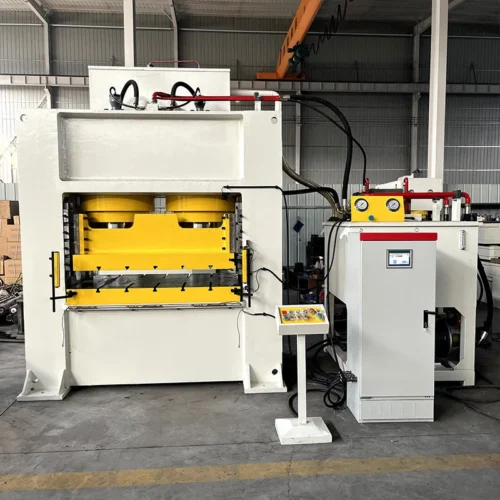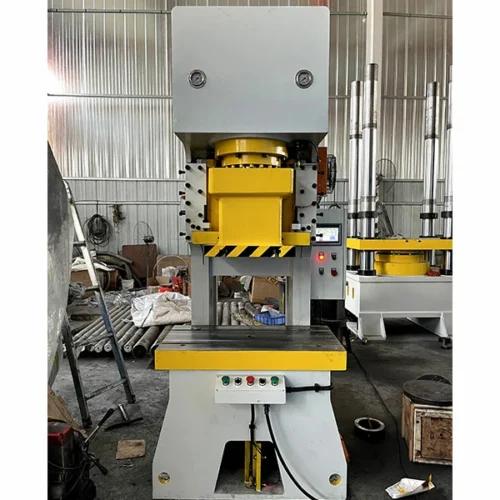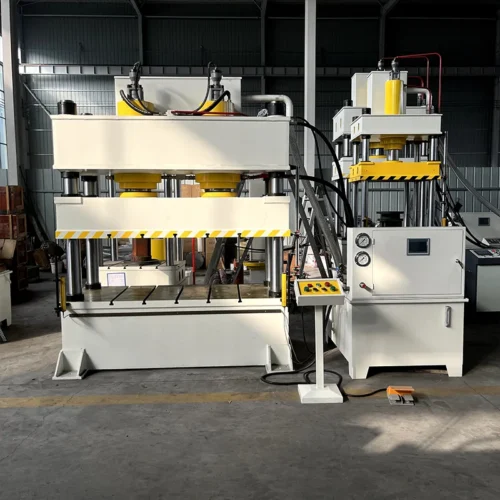

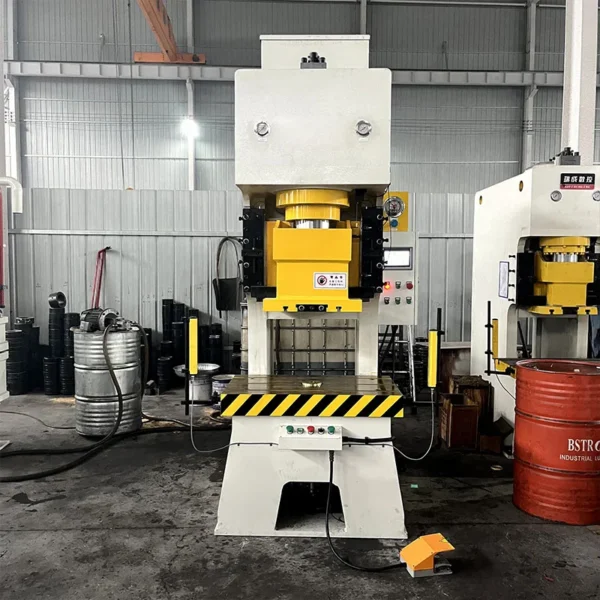
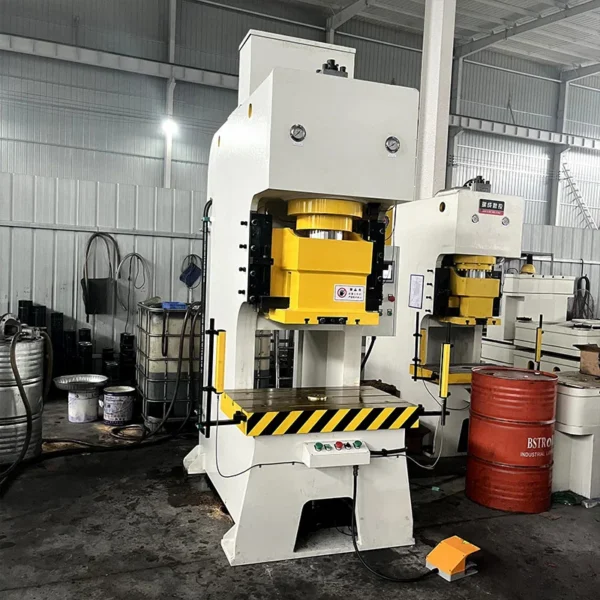
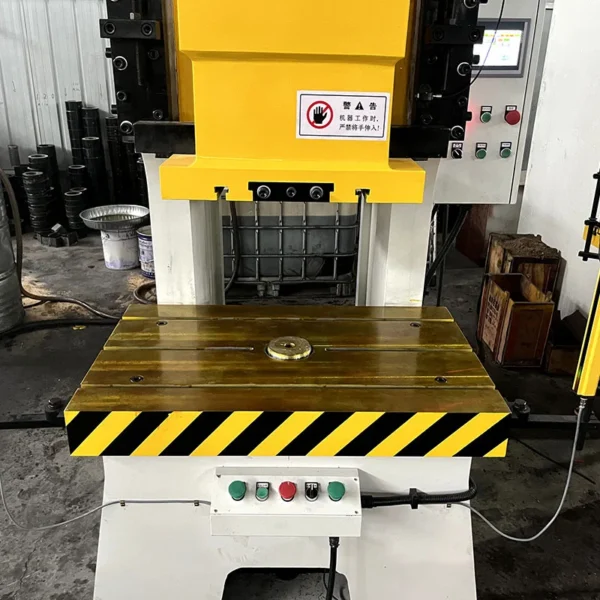
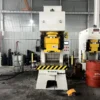
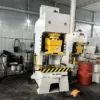
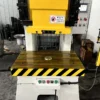
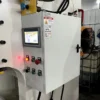
Small and medium parts running at high volume don’t need a massive frame — they need fast die access and a table that doesn’t waste floor space. This 125 ton C-Frame hydraulic press is built around that idea: an open-front C-shaped frame with a 550×400mm table, 500mm daylight opening, and a 63-ton lower ejector that clears finished parts before the next cycle starts.
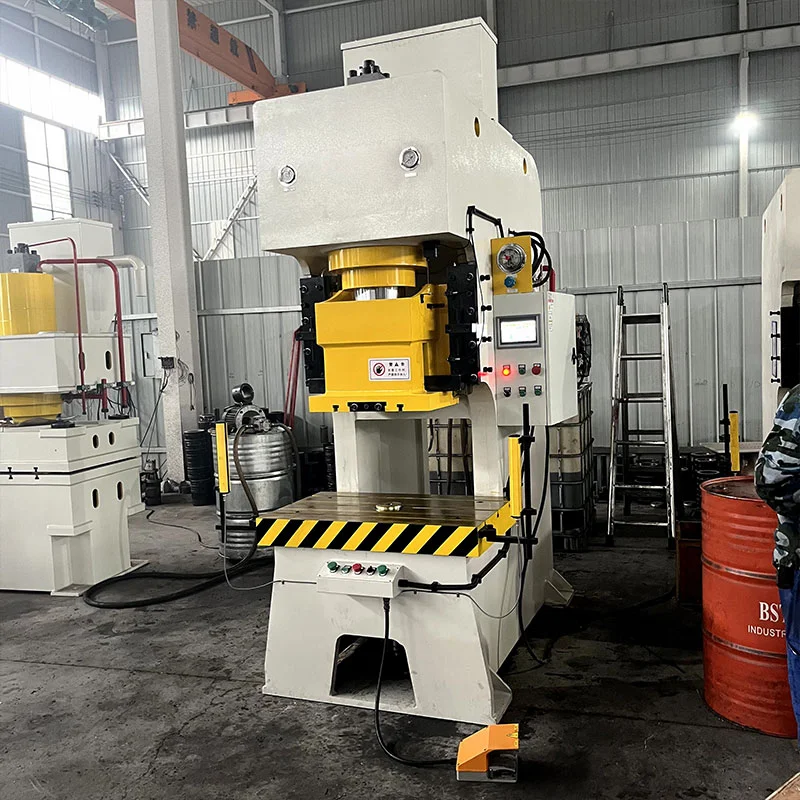
125-ton C-Frame hydraulic press with open-front frame for fast die changes.
The open C-shape is the whole point of this C-Frame hydraulic press line — unlike a four-column frame where posts surround the die on all sides, three open sides here mean an operator can load stock, swap tooling, or clear a jam without climbing around a post. That trade-off works because the parts running through this class of press are small enough that the frame doesn’t need four-post rigidity to hold tolerance.
Why This 125 Ton C-Frame Hydraulic Press Works for High-Speed Stamping
Precision guide accuracy
±0.1mm guide accuracy keeps part-to-part consistency tight enough for connector pins and other close-tolerance stamped components.
63-ton lower ejector
A dedicated 63-ton ejector with 200mm stroke pushes finished parts free of the die immediately, instead of relying on the operator to pry them loose.
Compact footprint
The C-shaped frame saves roughly 30% of the floor space a comparable four-column press would need, with around 25% lower energy draw per cycle.
Operator-friendly access
Open die access on three sides cuts mold setup time by roughly 40% compared to a fully enclosed frame, which matters most on shops running frequent die changes.
Applications
As a C-Frame press for metal stamping, this machine fits shops turning out small, precise parts in volume rather than large single-piece forgings. The metalforming industry broadly recognizes stamping and punching as distinct value-added processes from deep drawing or roll forming, a distinction the Precision Metalforming Association tracks closely across its member base — and this press is built specifically for the stamping and light deep-drawing end of that spectrum.
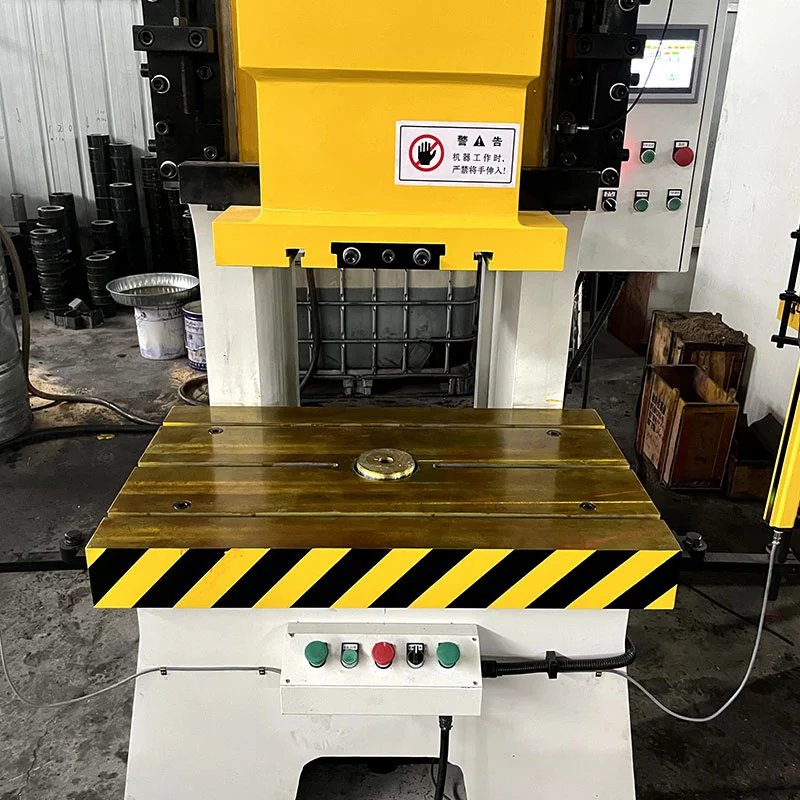
Open-front die access supports fast changeovers between stamping and deep-drawing tooling.
- Electronics connector punching
- Stainless cutlery deep drawing
- Metal bracket forming
- Precision hardware pressing
Technical Specifications
| Rated Pressure | 125 Tons (275,578 lbs) |
|---|---|
| Table Size | 550 × 400 mm (21.7″ × 15.7″) |
| Daylight Opening | 500 mm (19.7″) |
| Stroke | 260 mm (10.2″) |
| Lower Ejector Force | 63 Tons (138,891 lbs) |
| Ejector Stroke | 200 mm (7.87″) |
| Guide Accuracy | ±0.1 mm (±0.004″) |
| Voltage | 380V, 3-Phase |
Working With a C-Frame Hydraulic Press Manufacturer
As a C-Frame hydraulic press manufacturer, we configure ejector force, stroke, and table tooling holes around the die you’re actually running rather than shipping a fixed catalog spec — send us your die drawing and part volume and we’ll confirm fit before you order. You can read more about our factory on the about us page.
If your parts run larger or heavier than this table size comfortably handles, our four column hydraulic press line offers more swing and rigidity for bigger dies. For shops that want a fully enclosed, single-piece frame instead of open-front access, our closed frame hydraulic press line is worth comparing as well.
Get a Quote for This Press
Send us your die dimensions and part volume on WhatsApp and we’ll confirm configuration and lead time within one business day.
FAQ
Can this press handle both punching and deep drawing?
Yes, the 260mm stroke and 63-ton ejector support both punching operations and light-to-medium deep drawing, such as stainless cutlery blanks, on the same machine with a tooling change.
Why choose a C-Frame over a four-column press for these parts?
For parts within the table size and tonnage range this 125 ton C-Frame hydraulic press covers, the open-front design gives faster die access and a smaller footprint without sacrificing the accuracy these applications need. Four-column frames earn their keep on larger, heavier dies where rigidity outweighs the value of open access.
Is the table tooling pattern customizable?
Yes, table hole spacing and the ejector interface can be configured to match your existing die sets rather than requiring new tooling to fit a fixed table layout.