
A 40-millimeter steel plate lands on your cutting table with a three-millimeter bow across the width. You tack-weld it to a fixture, start the final weld, and watch the plate pull itself into a potato chip shape as residual stress releases. That is the moment most fabricators realize that straightening after welding costs far more than leveling before fabrication.
A hydraulic plate leveling press for steel plate straightening applies controlled, multi-point force to remove that bow and release trapped stress before the plate ever sees a weld torch. Unlike continuous roller systems, a hydraulic flattening press targets specific deformation zones with precision. This makes it the practical choice for shops that process thick structural plate in discrete batches.
This guide explains how to size the machine, what frame features actually matter, and why most buyers overlook the support span when calculating tonnage.
Table of Contents
- What a Hydraulic Plate Leveling Press Actually Does
- Why Thick Plate Demands a Different Approach
- Hydraulic Press vs Roller Leveler: Where Each Fits
- How to Calculate Tonnage and Size the Machine
- Real-World Applications in Heavy Fabrication
- Three Mistakes Buyers Make Every Time
- Decision Checklist for Your Shop
- Frequently Asked Questions
- Related Reading
What a Hydraulic Plate Leveling Press Actually Does
At its core, a hydraulic plate leveling press is a specialized machine that applies controlled, localized force to thick steel plates to remove warping and release residual stress. Instead of bending the entire material continuously, the hydraulic ram presses down on specific high spots or distorted zones.
Steel plate arrives from the mill with shape defects baked in: crossbow across the width, sweep along the length, and internal tension from uneven cooling. Even after initial visual straightening, a thick plate can pass inspection while retaining enough internal stress to distort during machining. When a milling operation removes material asymmetrically, it releases stress on one side but not the other. The plate then warps between setups, ruining dimensional tolerance.
This is why steel plate residual stress removal methods must go beyond visual flatness. A hydraulic press addresses the internal stress state by applying enough localized force to yield the material precisely where the defect exists.
Why Thick Plate Demands a Different Approach
The problem with thick plate is not just the sheer force required; it is the material variability. Mill plates cool unevenly. Quenching creates zones of differing yield strength across the exact same sheet.
Continuous processing systems apply uniform pressure across the full width. If the left side of the plate is softer than the right, uniform processing over-works one side and under-works the other. A hydraulic press solves this by allowing the operator to read the plate with a straightedge, place the ram exactly where the defect is, and apply force calibrated specifically to that location. It replaces global bending with targeted, discrete pressing.
Hydraulic Press vs Roller Leveler: Where Each Fits
Many buying guides assume you are just choosing between different hydraulic presses. In reality, the debate of thick plate straightening vs roller leveling is one of the most common dilemmas in heavy fabrication shops, and the first decision is whether a hydraulic press is the right technology at all.
When to choose a roller leveler: If your shop processes thin-to-medium coil stock continuously at high volume, and the primary defect is uniform longitudinal curvature (coil set), a roller leveler is the faster and more economical choice. A hydraulic press is the wrong tool for high-volume, thin-sheet continuous feeding.
When to choose a hydraulic press: The decision hinges on three factors that factory brochures rarely discuss honestly:
- Batch size & handling: A hydraulic press processes one discrete sheet at a time. There is no threading coils or aligning feed tables. For shops receiving plate in discrete sheets, this adds efficiency, not friction.
- Distortion pattern: Roller systems struggle with crossbow, edge waves, and localized bumps from handling damage or welding. A hydraulic press places the ram exactly where the defect is, supported by V-blocks or flat dies.
- Thickness range & ROI: Roller levelers for plate over 50mm require massive separating force and a footprint that rivals a small building. A hydraulic press delivers the same localized force in a standard workshop bay. For a shop processing 20 to 50 tons of thick plate monthly, the hydraulic press pays for itself through reduced scrap and eliminated subcontractor fees.

How to Calculate Tonnage and Size the Machine
Selecting tonnage for leveling follows different logic than stamping. In stamping, the press must overcome shear strength in a single stroke. In leveling, the goal is to exceed the yield strength locally at the point of maximum deflection, while supporting the plate at two adjacent points.
When engineers ask how to calculate tonnage for plate leveling press requirements, they start by treating the plate as a simply supported beam with a concentrated load at mid-span. The required force depends on the section modulus, yield strength, and the span between supports. For a rectangular steel plate, the section modulus (Z) equals width times thickness squared, divided by six. The ram force required equals four times the yield moment divided by the support span.
To make this practical, let’s look at two real-world calculation examples:
Example 1: 40mm Mild Steel (Yield Strength 250 MPa)
Assume a plate width of 1000mm and a support span of 800mm. The section modulus is roughly 266,666 mm³. Multiplying by the yield strength gives a yield moment of 66.67 kN·m. Dividing by the support span and applying the multiplier gives a theoretical ram force of about 333 kN (approx. 34 tons). Adding the standard 30% margin for friction and work-hardening brings the requirement to roughly 44 tons. A 50-ton or 63-ton press is perfectly sufficient here.
Example 2: 50mm High-Strength Steel (Yield Strength 460 MPa)
Now assume a wider plate (1500mm) and a 1000mm support span. The section modulus jumps to 625,000 mm³. The higher yield strength and larger dimensions push the theoretical ram force to roughly 1150 kN (approx. 117 tons). Adding the 30% margin pushes the requirement to over 150 tons. In this scenario, you immediately need a 160-ton or 200-ton machine.
These examples illustrate why a 315-ton hydraulic plate leveling press is considered the sweet spot for heavy fabrication. It comfortably handles the 150-ton requirements of 50mm high-strength steel with plenty of reserve capacity, while remaining cost-effective for smaller jobs.
Frame rigidity matters as much as tonnage. Every time the ram pushes, the frame absorbs the reaction load. A flexing frame produces inconsistent results; the gauge reads one number, but the plate tells a different story after unloading. Thick plate steel construction and full-penetration welds keep the frame true under load.
Support span selection is the most overlooked variable. A long span reduces the force required but increases the risk of sagging. A short span increases force demand but gives better control over the bend radius. For plates under 30mm, a support span of 8 to 12 times the plate thickness provides a workable compromise. The supports themselves must be rigid; a support that deflects under load acts like a spring, storing energy that releases unpredictably.

Real-World Applications in Heavy Fabrication
Pressure vessel fabrication: A cylindrical shell segment starts as a flat plate. If that plate carries crossbow, the rolled cylinder closes with a gap at the longitudinal seam. Welders compensate by pulling the edges together, introducing locked-in stress. Leveling the plate before rolling removes that downstream rework.
Bridge and heavy structural contractors: Base plates for column connections must sit flat to transfer load evenly. A plate that rocks on its grout bed creates a structural risk. A hydraulic flattening press corrects the plate in the shop before it reaches the field.
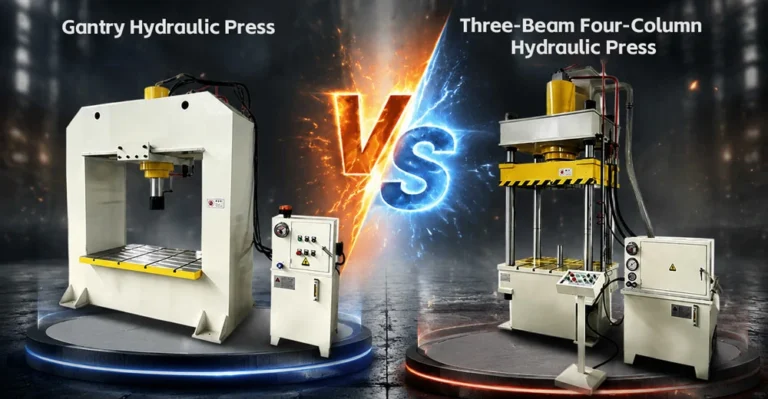
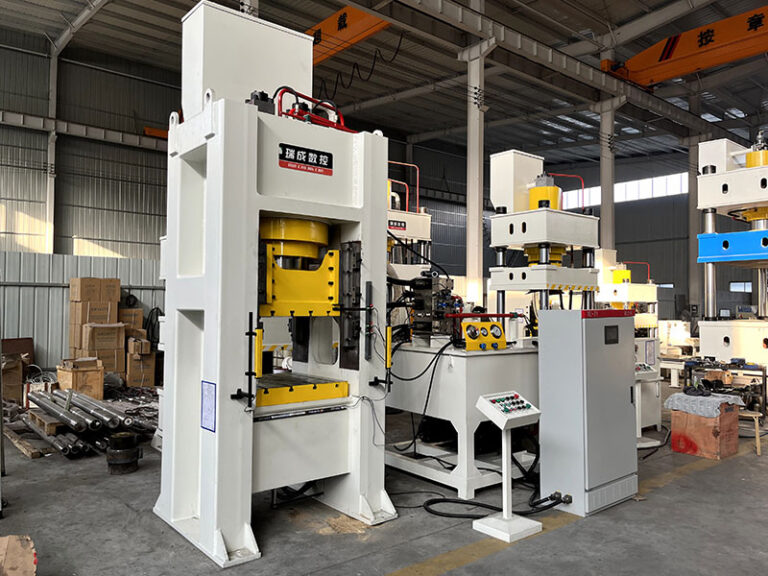
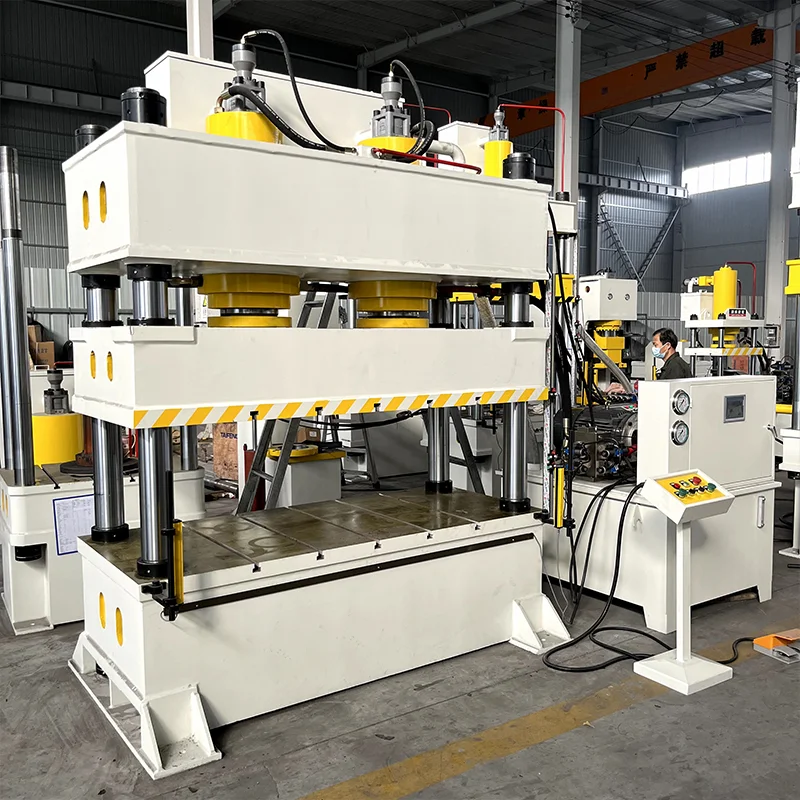
Shipbuilding and Energy: Hull segments, deck plates, and wind tower flanges require tight flatness tolerances. Plate thickness often exceeds 40mm. A hydraulic press handles these parts individually, straightening weld distortion from tack-up fixtures. A standard four-column structure provides superior resistance to off-center loading compared to C-frame designs, ensuring uniform force distribution when correcting asymmetric warping.
Three Mistakes Buyers Make Every Time
Mistake 1: Sizing by stamping logic. Leveling requires sustained force at partial stroke, not peak force at bottom dead center. The hydraulic system must deliver consistent pressure during the dwell phase. Undersizing the press for this duty cycle leads to overheated oil and inconsistent flatness.
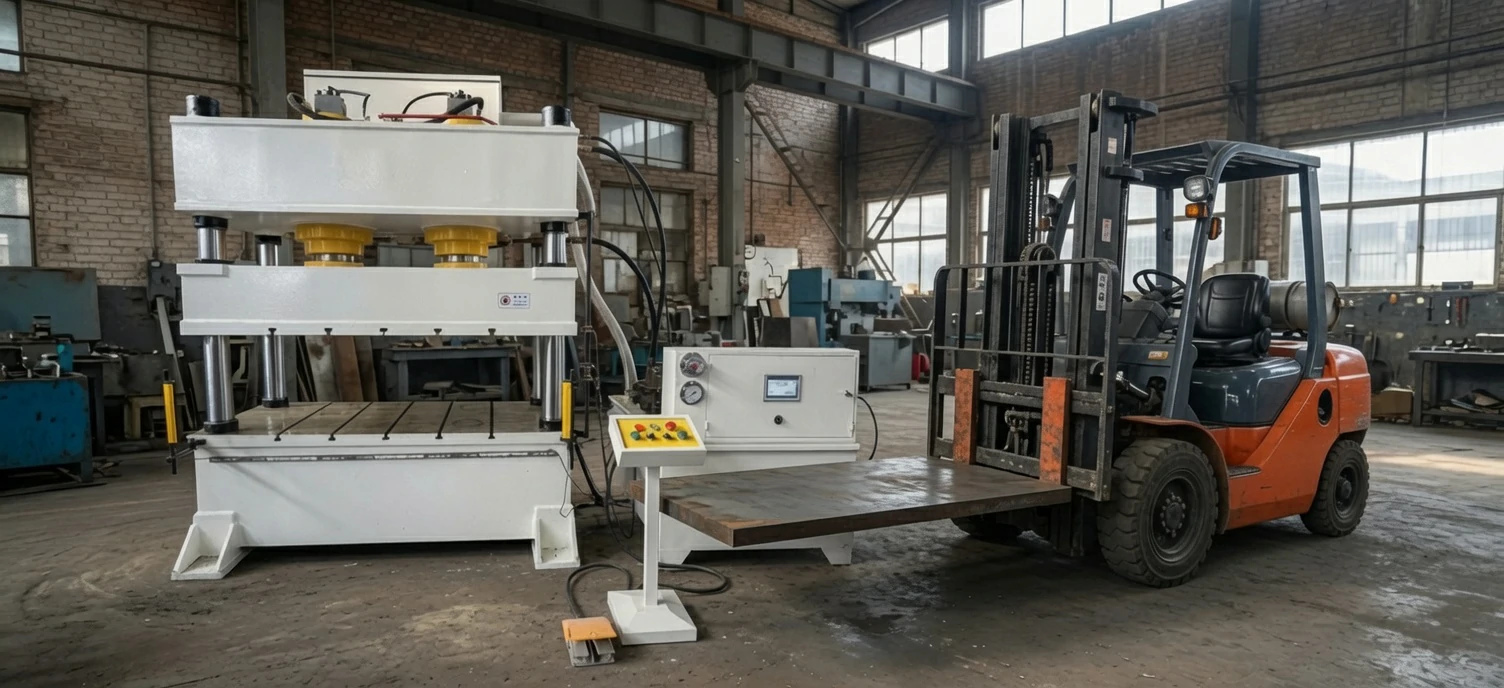
Mistake 2: Ignoring table support layout. The ram pushes down; the table pushes up. If the table deflects, the plate deflects with it. A precision-milled table with integrated T-slots for support bolts prevents this.
Mistake 3: Treating a leveling press as a general hydraulic press. Leveling demands slow, controllable approach speeds. A fast-stroke press built for blanking will frustrate operators who need to nudge the ram, hold, measure, and nudge again. Verify that the control system offers an inching or jog mode.
Decision Checklist for Your Shop
| Parameter | Rule of Thumb |
|---|---|
| Required tonnage | Calculate from plate thickness, yield strength, and support span. Add 30% margin. |
| Table dimensions | Length must exceed longest plate by 200 mm minimum. |
| Daylight opening | Must exceed plate thickness plus fixture height plus backing plate clearance. |
| Frame construction | Welded steel with full-penetration welds and stress relief. |
| Ram control | Low-speed approach, jog mode, and real-time pressure display required. |
| Tooling | Flat dies standard. Verify custom nose availability for localized pressing. |
Frequently Asked Questions
What is the difference between plate leveling and plate straightening?
Plate straightening removes visible curvature like coil set from the surface. Plate leveling removes internal residual stress by bending material past its yield point so it stays flat after cutting or welding. A hydraulic press achieves true leveling through controlled, multi-point force application.
How much tonnage do I need for a hydraulic plate leveling press?
Calculate the bending moment at yield based on section modulus and material strength. For mild steel plate up to 50mm thick, a 315-ton press handles most jobs with proper support spacing. Always add a 30% margin to the theoretical force.
Why does my steel plate warp again after straightening?
Standard straightening only redistributes internal stress. When heat from welding triggers stress release, the plate warps again. True leveling requires force sufficient to exceed the yield point locally, permanently eliminating the internal stress state.
Which is better for thick plate: hydraulic press or roller leveler?
Roller levelers excel at continuous thin-plate processing. For thick plate over 25mm or batch processing of discrete sheets with localized distortion, a hydraulic press offers better defect targeting and a smaller workshop footprint.
Can I use a standard four-column hydraulic press for plate leveling?
A standard four-column press can perform leveling if it offers slow ram control, adequate table size, and jog mode. However, presses purpose-built for leveling include precision-milled tables and integrated support T-slots that general presses often lack.
Related Reading
- Explore how hydraulic presses support energy and renewable energy applications from wind tower fabrication to pipeline construction.
- Browse our full range of hydraulic press solutions for metal forming, straightening, and heavy fabrication.
Not sure whether a hydraulic press or a roller leveler is the right fit for your specific plate mix? Share your material thickness, yield strength, and batch volume with our engineering team for an objective workflow analysis.
Request Workflow Analysis